Plants Get Wearables to Track Their Health
With new sensors, farmers could use real-time information to manage crop conditions before visible signs of plant stress appear
Written by Mike Silver, Tufts University
A smartwatch can tell us the level of oxygen in our blood, when our sleep is restless, or the number of steps we take in a day. Now imagine that kind of tracking ability for plants.
By the time farmers see curling leaves or stunted growth in their fields, their crops may already have spent days under stress. A new innovation in plant “wearable” sensors aims to catch those distress signals earlier—before the plant visibly suffers, allowing farmers to respond and help their crops thrive.
In a recent study, researchers created tiny tattoo-like sensors that adhere to leaf surfaces and a stretchable band that wraps around stems. Together, they track two vital signs of plant life—the temperature and humidity beneath the leaf’s surface, and whether the stem is still growing. Even more striking, the system runs without an external battery, scavenging power from moisture evaporating from the plant itself.
“The larger promise is not merely that one plant can wear one sensor,” said Sameer Sonkusale, professor of electrical and computer engineering at Tufts and senior researcher in the project. “It is that fields could one day contain networks of plant-level monitors, each reporting early signs of thirst, salt stress, disease or nutrient imbalance. Satellites and drones already give farmers a bird’s-eye view. Plant wearables could provide something more intimate: the plant’s-eye view.”
Current methods in monitoring crops use satellite imagery and drones to get visible, infrared, and microwave data that map out greenness, uneven growth, temperature, pest damage, soil moisture, and other big picture measurements of crop stress. Soil sensors can measure moisture, temperature, pH, and some nutrient levels. And weather stations provide information on air temperature, humidity, rainfall, wind, and sun exposure.
While those measurements are useful, they focus on conditions that may affect the crops in the future or an assessment of damage already done. “The leaf sensor is more of an early warning system showing how the plant is responding in the moment, before visible signs appear,” said Nafize Hossain, a graduate student who led the research in the Sonkusale lab.
The sensors can also be extended to track other important indicators of plant health, such as levels of important nutrients and plant hormones that are early signals of root, leaf, stem, and fruit growth, as well as response to pathogens.
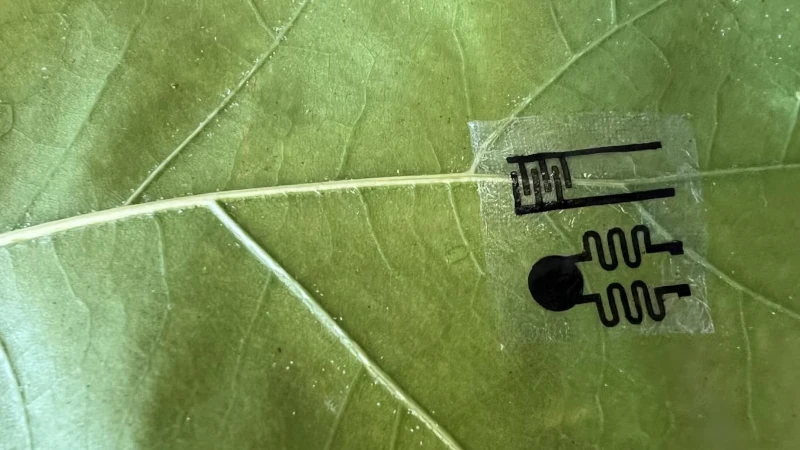
“Wearable” plant sensor designed to detect distress signals. Credit: Nafize Hossain
Stress Trackers
Resembling a temporary tattoo, the leaf sensor is thin, flexible, and can sit on uneven surfaces, allowing the plant to breathe and bend in the wind without damaging it. “Other plant sensors exist, but their ability to track multiple stressors and growth-related parameters is limited, and the technology often relies on external batteries, which complicate field deployment,” said Hossain.
The sensor developed by the researchers provides information on the “vapor pressure deficit,” or VPD. It’s a technical term, but it describes something very intuitive—how likely the air is to pull water from the plant. When VPD is high, the air is dry and pulls moisture from leaves more aggressively. Plants respond by closing their stomata, the tiny pores that regulate gas exchange and water loss. That can protect them from dehydration, but it also slows photosynthesis and growth.
The post Plants Get Wearables to Track Their Health, written by Mike Silver, first appeared in the Tufts University Newsroom Tufts Now.
Tufts University, located on campuses in Boston, Medford/Somerville and Grafton, Massachusetts, and in Talloires, France, is recognized among the premier research universities in the United States. Tufts enjoys a global reputation for academic excellence and for the preparation of students as leaders in a wide range of professions. A growing number of innovative teaching and research initiatives span all Tufts campuses, and collaboration among the faculty and students in the undergraduate, graduate and professional programs across the university’s schools is widely encouraged.