Donna Sanders is the Asst. Producer, Food Editor, and official photographer for the network TV, YouTube and National Ag In The Classroom show Where The Food Comes From. This is her behind-the-scenes look at NASA’s space crop research facilities, a Falcon 9 launch at Kennedy Space Center, and the people working to solve the challenge of growing food for future missions to the International Space Station and a lunar colony.
Picture this: 6 a.m., July 16, 1969. Three men are making final preparations for what will be the journey of our lifetime. And one highly esteemed journalist – the legendary Walter Cronkite – has just begun his coverage for CBS News in the Media Building at Cape Canaveral’s Kennedy Space Center.
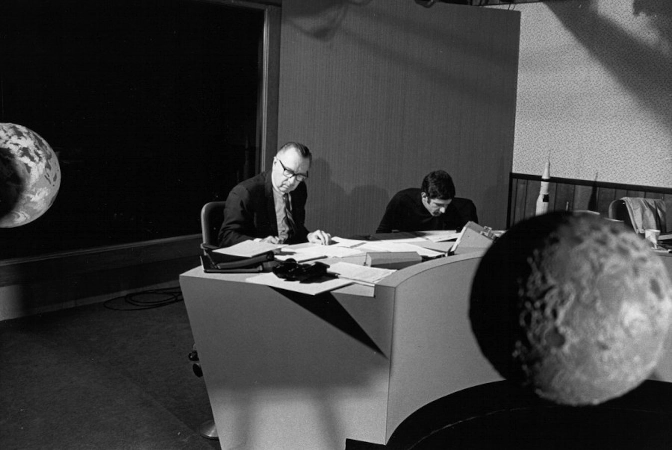
Walter Cronkite. Credit: NASA
Per Mr. Cronkite, “Three hours and 32 minutes until man begins the greatest adventure in its history… This morning, Man is about to launch himself on a trip to the moon with the expectation of landing there. The dawn of this day heralded the dawning of a new age.”
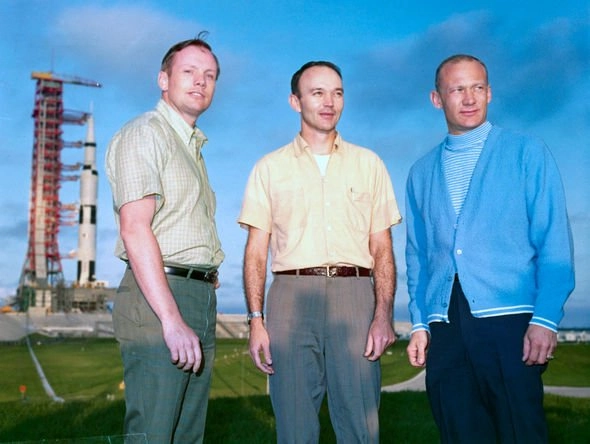
(L-R) Neil Armstrong, Michael Collins, and Edwin “Buzz” Aldrin. Credit: NASA
Fast forward to July 31, 2026 – 56 years later – and I am standing in that very same Media Building remembering my 10-year-old self watching Mr. Cronkite on television preparing the nation for Apollo 11’s flight to the moon. Yes, you know, “The One”: Neil Armstrong, Michael Collins, and Edwin “Buzz” Aldrin.
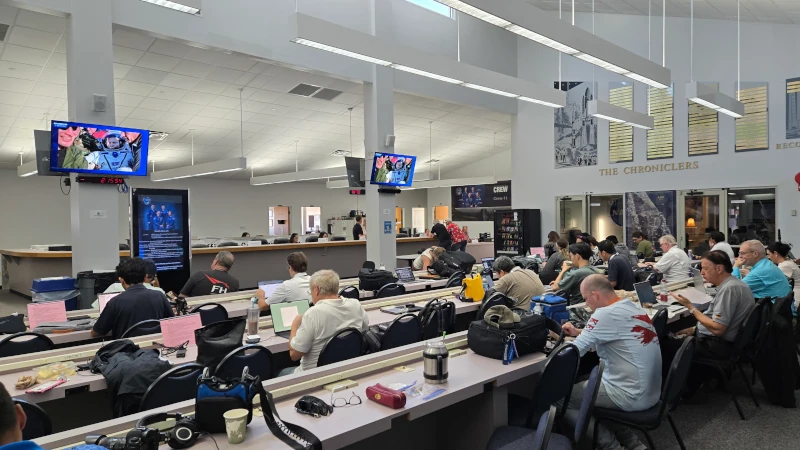
Press area in the Media Building. Credit: Donna Sanders
And as I looked around that historic building, I could feel Mr. Cronkite’s presence and hear his voice – so surreal. Talk about goosebumps. Holy rocket fuel, Batman! But why are me and Producer and Host Chip Carter and crew of Where The Food Comes From at Cape Kennedy?
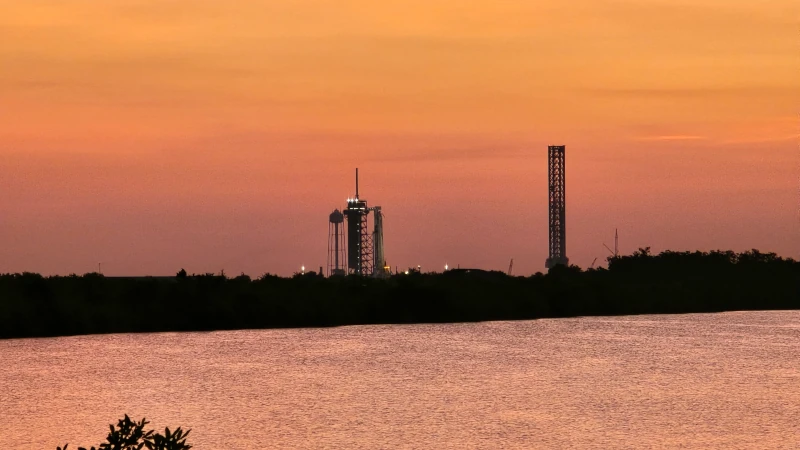
Falcon 9 on launch pad at dawn. Credit: Craig Ricciardi
I will tell you, but you might not believe me: To film the launch of NASA Crew 11 aboard a Falcon 9 rocket to the International Space Station (ISS). Makes no sense right? After all, WTFCF is a show about food and farming. Hang on…
A couple of years back, Chip caught wind that the University of Florida was growing Earth crops in 50-year-old moon soil. He wondered, “Why now?” We came to Cape Kennedy in April to check it out – what we saw convinced us this story had to come to air and in a big way.
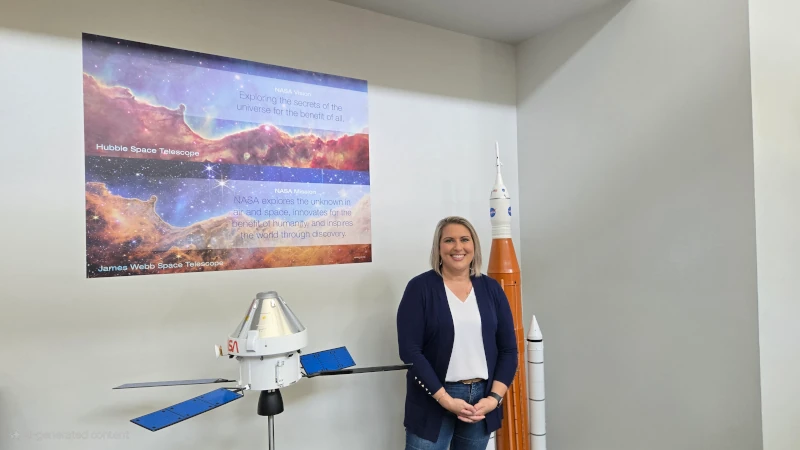
NASA Public Affairs Specialist Leah Martin. Credit: Donna Sanders
Flash forward to Wednesday, July 23. Following a rigorous security clearance process that lasted weeks, we drove through the gates at Cape Kennedy. Being NASA, it wasn’t like we could just wander around. We had to leave our cars and move all the equipment – checked by a K9 team – into Public Affairs Specialist Leah Martin’s van. Leah was one of our guides and chaperones for the day.
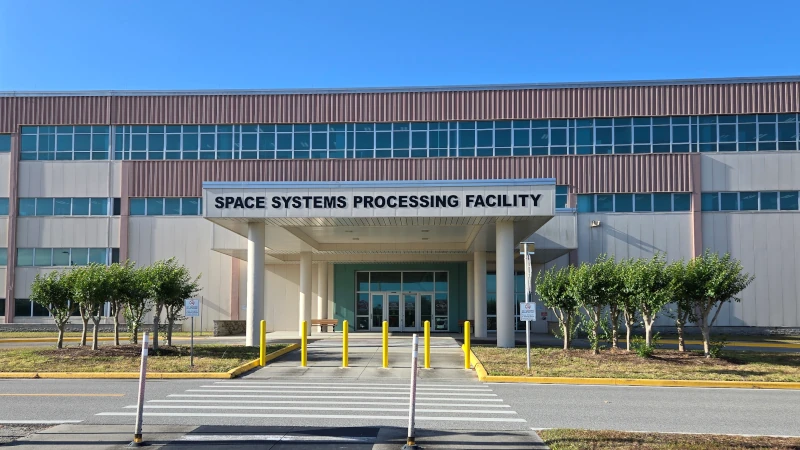
NASA’s Space Systems Processing Facility. Credit: Donna Sanders
Inside we were greeted by NASA Public Affairs Specialists Danielle Sempsrott and Stephanie Plucinsky. With a quick right through a pass-protected door we arrived at the Space Crop Production Lab to see – wait for it – how food will be grown in space!
Fun Fact: I don’t think many of us realize that people have been living in space every second of every day since November 2, 2000. For the future of space exploration, the need for missions to be food-sufficient has become a top priority.
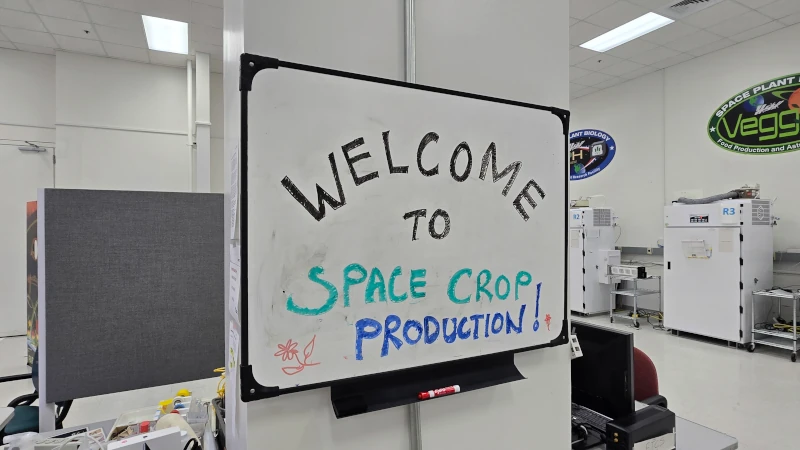
Credit: Chip Carter
I was a bit surprised when we entered the lab. There were very few plants in sight. I was expecting a greenhouse environment, lights and a lot of tubing. Instead, I saw huge containers with vacuum-lock doors.
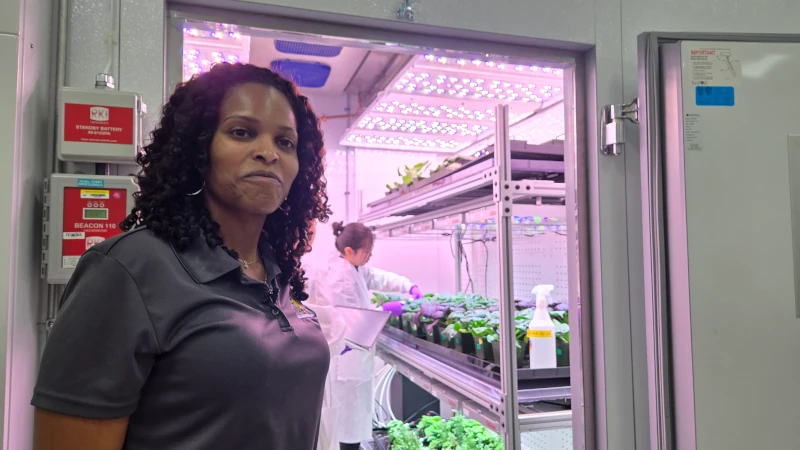
NASA Plant Biologist Team Lead/Scientist LaShelle Spencer. Credit: Donna Sanders
Our first peek into what was going on came from Plant Biologist Team Lead Scientist LaShelle Spencer. LaShelle spoke about the need for crop diversity to keep the astronauts’ diet exciting. Fun Fact: LaShelle told us the astronauts love spicy food because their senses of taste and smell are dulled in Zero G. Their current favorite? Shrimp cocktail.
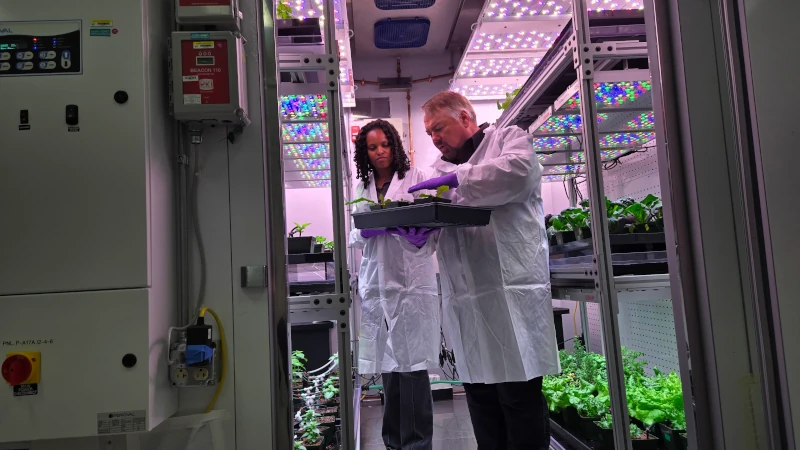
LaShelle Spencer and Chip Carter in vegetation container. Credit: Donna Sanders
So, what’s behind Door #1? Dandelions! And spinach, basil and other greenery all growing under extremely controlled conditions. It’s a new wrinkle on the old idiom, “Variety is the spice of life.” I am sure the astronauts will appreciate it.
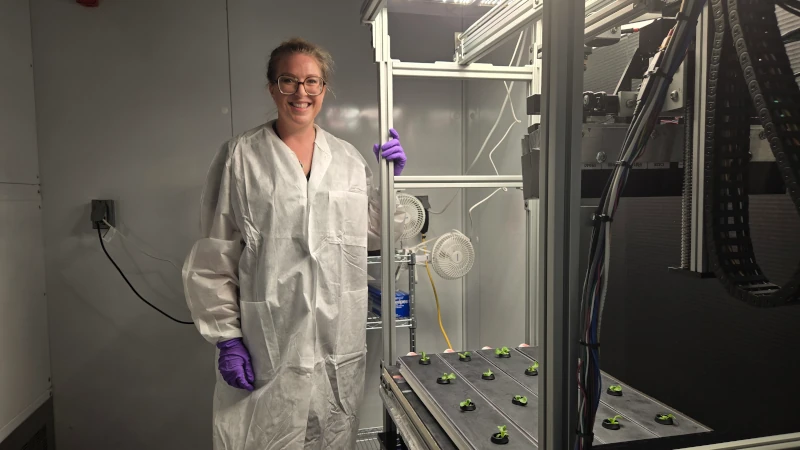
Scientist 1 Rachel Tucker. Credit: Donna Sanders
NASA Scientist 1 Rachel Tucker was so very patient with me and answered every question. She explained the experiments in each unit mimic traditional farming issues; floods, drought, soil problems… all just in case.
The main challenge is the all-important water delivery system. I chuckle when I think about astronauts trying to catch floating droplets. So how do you water plants?
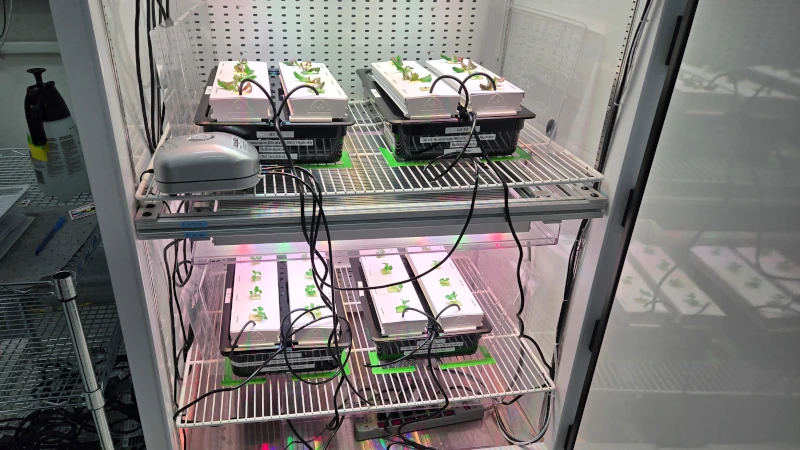
Space plant watering tube system. Credit: Donna Sanders
Easy: A simple and quite effective tubing system that delivers drops directly into the soil from the bottom of an otherwise sealed container that still lets the plant itself poke through.
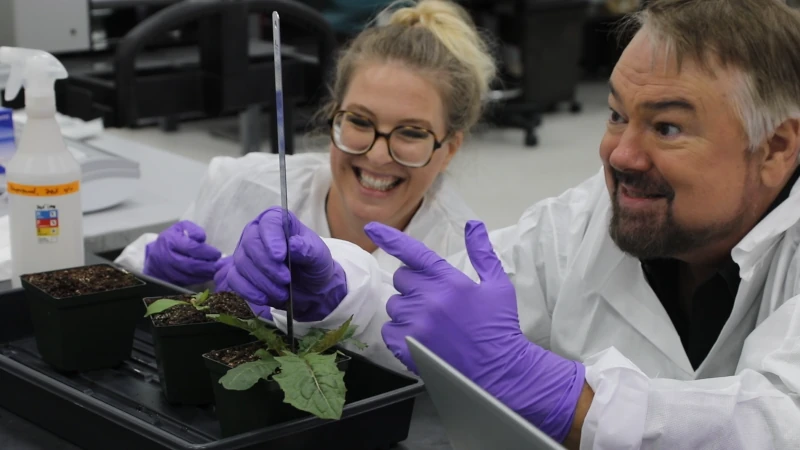
Rachel Tucker and Chip Carter. Credit: WTFCF Staff
Each plant has to be precisely measured and weighed. Plant consistency is key because of tight working conditions on the ISS and future space colonies. Every inch of space, every ounce of weight matters.
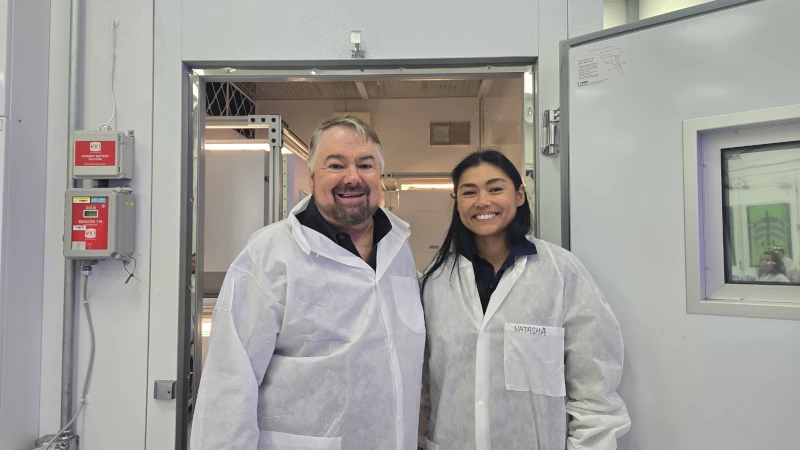
Chip Carter and Project Scientist Natasha Haveman. Credit: Donna Sanders
NASA Project Scientist Natasha Haveman took our mission one step further. She explained that nothing goes to waste. Like any good farmer they’re stewards and make the most of what they have. They even recycle dirty cotton t-shirts into growth medium for mushrooms.
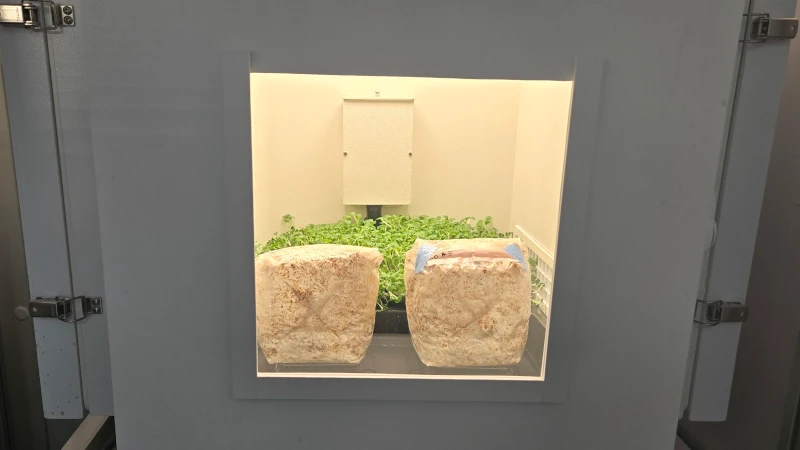
Mushrooms and sprouts. Credit: Donna Sanders
My head was spinning by this point. One thing I couldn’t figure out was why everyone seemed so happy? It turns out because they truly are. They gushed about how much they love their jobs – it’s easy to see how true this is.
Some sort of important tour was starting behind us at that point, so we temporarily left the lab and piled into Leah’s van for a tour.
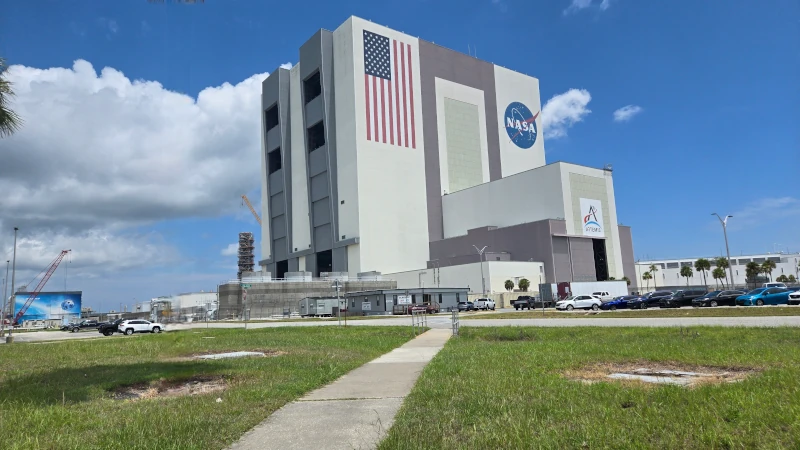
NASA Vehicle Assembly Building. Credit: Donna Sanders
First stop, the NASA Vehicle Assembly Building (VAB). Commissioned in 1964 and built in 1966 to assemble the vehicles that were sent to the moon, it currently houses Artemis, which will soon take us back. According to Leah, “Every vehicle that has ever carried a human into outer space was assembled in that building.”
I can only picture what it must look like inside. We couldn’t go in. Even our top-level security clearance didn’t go that far. We filmed a few transitions and other setups for the show with that amazing backdrop, then it was back to the Space Lab for a few more reveals.
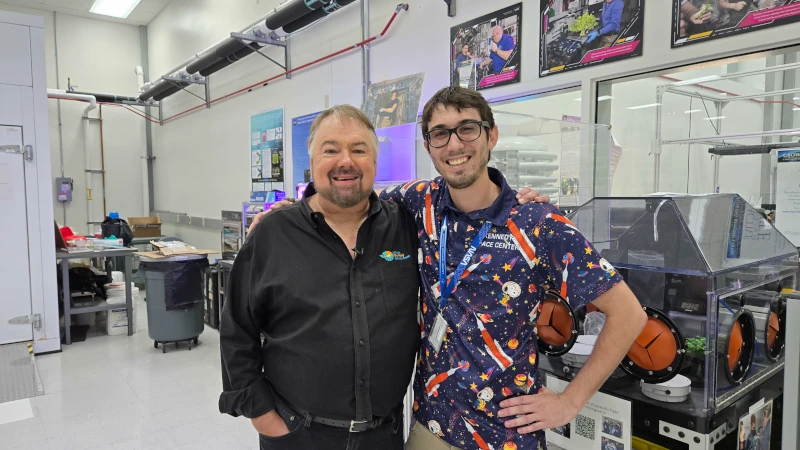
Chip Carter and NASA Research Intern Dr. Tyler Descenza. Credit: Donna Sanders
Back at the lab we meet Dr. Tyler Descenza, from Florida Institute of Technology. One of Tyler’s assignments was to recreate the lunar soil Apollo astronauts brought back to test what might grow in it. The real stuff is quite rare, so Tyler had to make the substitute. I did ask about the recipe but – no shocker – it’s top secret. There was a lot of that going around.
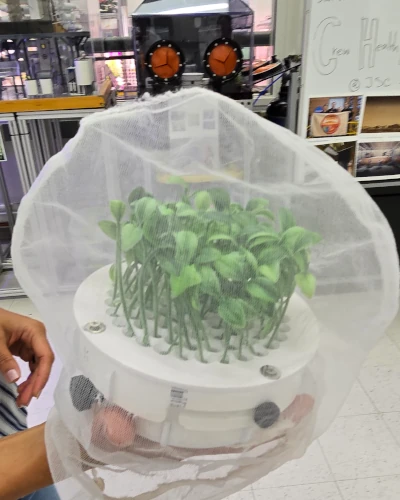
Harvester. Credit: Chip Carter
So you know how they’re going to water and grow plants – what about harvest? Look closely at this white gadget. It works like a pepper grinder; twist and it chops sprouts. The little net captures the greens before they float away. Bonus – the net makes a handy rinsing container. Efficiency at its finest.
After we poked our heads in all the bays and saw all the crops growing in a variety of mediums, some for Zero G, some for a lunar colony, Day One was done.
And now it’s on to Launch Day. T-Minus 26 hours and counting.
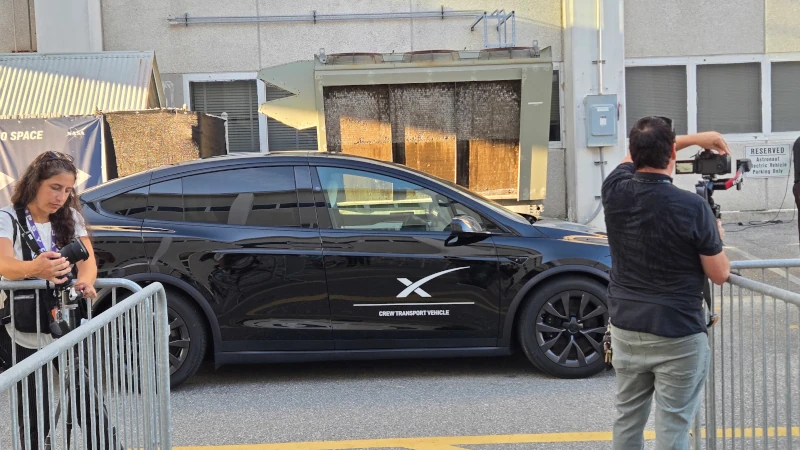
NASA escort vehicle. Credit: Chip Carter
We start bright and early, 5:30 a.m. to be specific, and that’s just to get to get credentials for the Media Building and viewing pad.
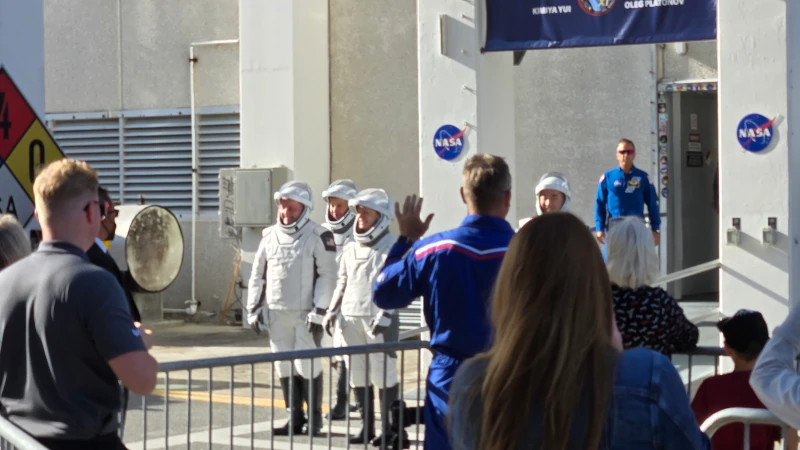
Crew 11 walking out of the operations building. Credit: Chip Carter
By 8 a.m., during the astronaut walkout, Chip manages to get a couple of pictures of Commander Zena Cardman saying goodbye to her mom. Disclaimer: They are real tear jerkers. Remember, they’ve been in quarantine, so there’s no touching.
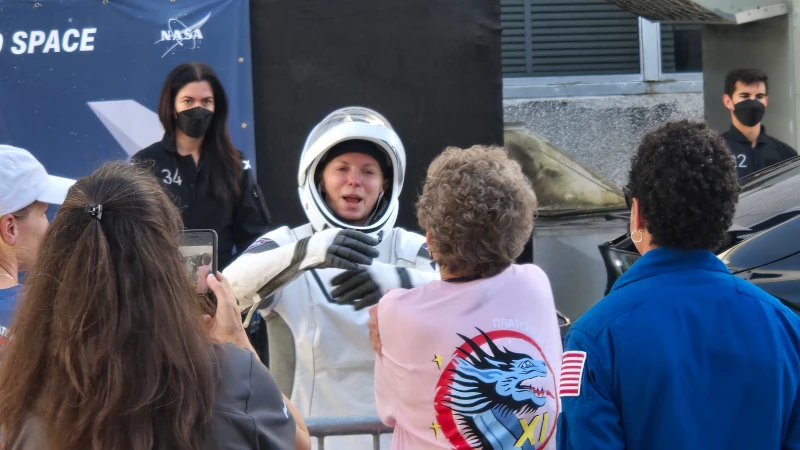
Commander Zena Cardman saying goodbye to her mom. Credit: Chip Carter
Commander Zena Cardman gave her mom an air hug. Nope – no touching.
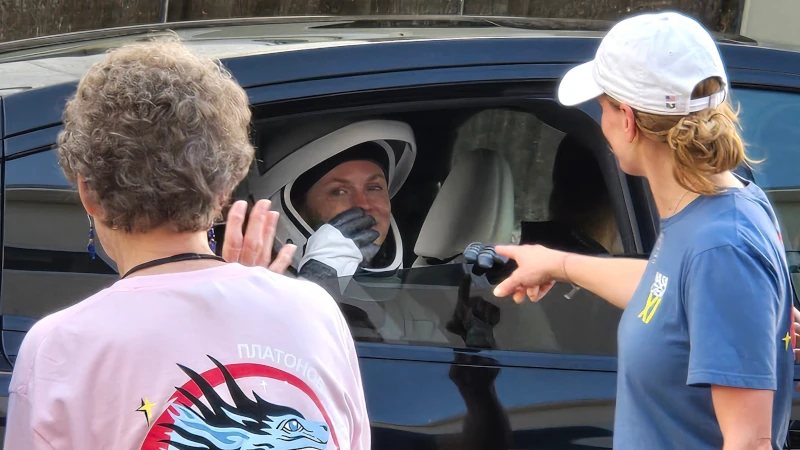
Commander Zena Cardman blowing a kiss to her mom. Credit: Chip Carter
And then blowing Mom a goodbye kiss. So much emotion in this picture, Pulitzer Prize-worthy.
It is still very early and liftoff isn’t until 12:09. Time to grab another cup of coffee and interview University of Florida Institute of Food and Agricultural Sciences Dr. Wagner Vendrame, whose work is onboard the Falcon 9.
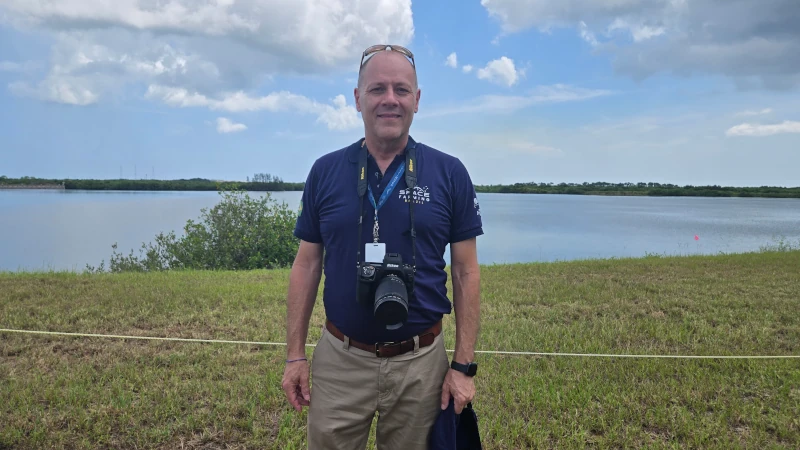
Research Scientist, University of Florida Dr. Wagner Vendrame
Dr. Vendrame is a seed specialist. Watching him stare at Falcon 9, I ask how he feels seeing his babies heading to space. “Excited. I feel like crying,” he replies. Which is understandable – and relatable.
His seeds will be returning to earth when the mission ends. After a period of quarantine, he will analyze for nutrient uptake and the effects of Zero G. And we’ll be one step closer to feeding humans in space.
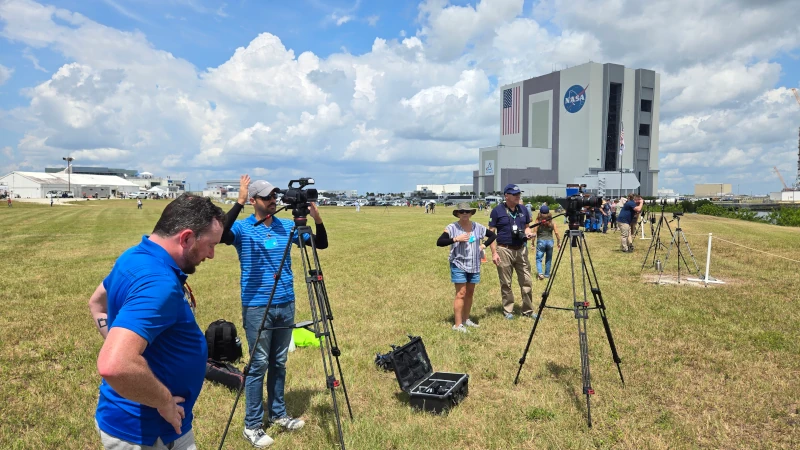
Where The Food Comes From crew and Dr. Vendrame in viewing area. Credit: Chip Carter
Launch time is close and the excitement is palpable. Media from all over the world spread across the grassy patch facing the launchpad, jockeying for position.
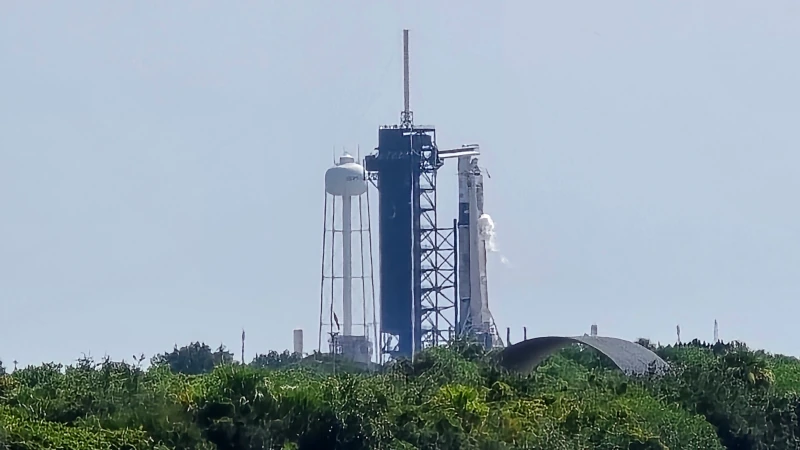
Falcon 9 on launch pad. Credit: Craig Ricciardi
The camera crew and Chip are in positions staked out early that morning. My job is to watch the countdown clock; the crew is far ahead on the other side. My job was to cue Chip, who was facing away from the rocket, to start our carefully timed opening, which we hoped to synchronize with launch.
We knew the launch would be loud and the end of Chip’s spoken opening would most likely be drowned out. Our solution? Cue cards to show the opening words to every episode.
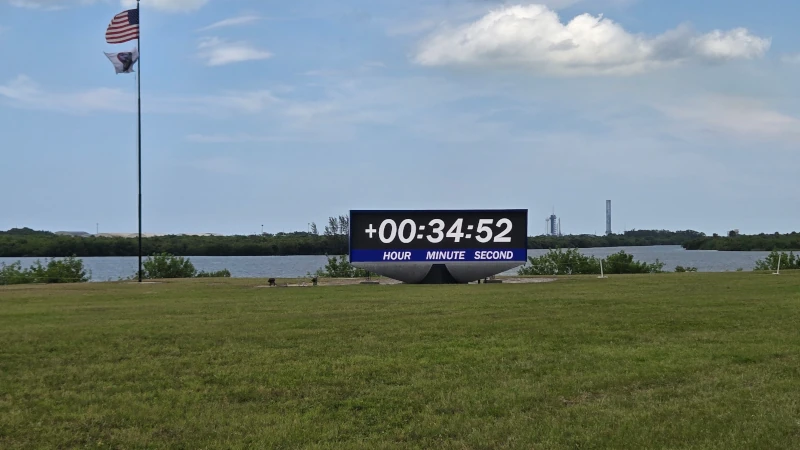
Launch countdown clock. Credit: Chip Carter
Now picture this. I am standing there watching the countdown clock, giving hand signals as it drops, waiting for the critical 30-second mark to cue. What happened next still makes my stomach nauseous and my head hurt: The clock stopped!
My thoughts are racing – OMG! Did it break? Am I missing something? Now what? Let’s face it, it’s not like we can call the rocket back and do a retake or fix it in post!
Chip is looking at me, waiting for a simple signal. But what he sees is me hopping around waving my arms up and down. He’s as clueless as I am.
The launch is scrubbed. With 33 seconds remaining, an ugly black cloud crept into range, close enough to call it off. Silver lining – we’re on again for the next day at 11:43 a.m. Fun Fact: Launch timing for every mission is critical. If you don’t hit the right window, it’s a no-go.
My first thought is for the poor astronauts. They have to sit on the rocket for a few more hours before going back to quarantine and getting ready to relive the whole day. As a mom, I don’t think I could have handled saying goodbye to my daughter again. As for us – it’s time to check back in the hotel.
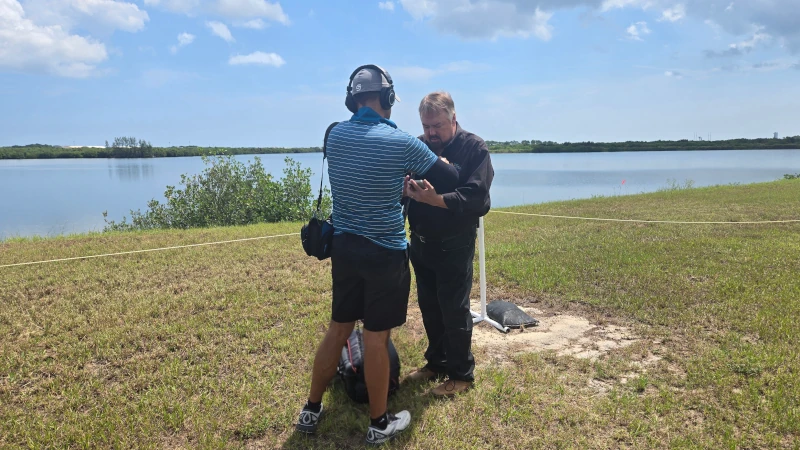
Chip Carter being miked up prior to launch. Credit: Donna Sanders
The next day arrives with the infamous Florida sunshine and heat that August brings – but the same amount of excitement. As launch approaches, the clouds began to gather. I silently wonder if it will be scrubbed again.
Chip is in the process of getting miked up and asks aloud if we should run the opening with the cue cards a few more times while we wait. It’s getting close. I think he’s a little nervous.
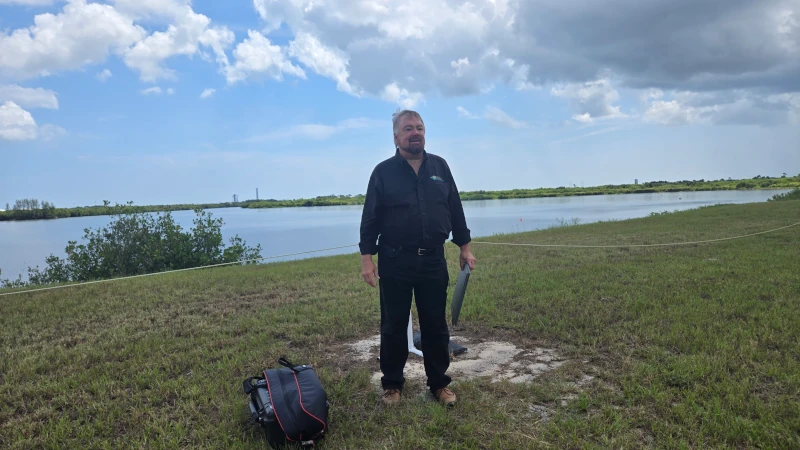
Chip Carter. Credit: Donna Sanders
Then we hear it. A very loud siren. I have no idea what it means, could be the “go” signal, could be the end of the world, we didn’t hear it yesterday. The veteran crew next to me seems unhappy. The clouds are rolling in and the wind is whipping up and – was that a bolt of lightning?
Chip is still nervously running through the opening. I take my position by the countdown clock, ready to give the crucial 30-second signal.
Now I am watching the clock, watching Chip, and I can feel my anxiety level going up. With a minute left to launch, Chip is still rehearsing. I’m already panicking – and now comes a gust of wind that blows the cue cards out of his hands and 20-yards-away.
The countdown continues – just seconds left and our host is reshuffling cue cards while running to his mark. And I am dying. By this point I have my hands atop my head and am literally trying to scream the countdown over the rising engine noise.
The mission is not scrubbed. As Chip slides back into place, still facing away from the rocket and with no idea what’s happening behind him, he begins the show opening. Falcon 9 launches behind him. He completes the opening. We are done. We are thrilled. We got it. And Chip begins his happy dance.
Until our lead cameraman, very quietly, very unassumingly says, “Yeah, but you missed your mark.”
No! In his scramble to recover the cards, put them back in order and get back to his mark, Chip slid a full three feet to his right of where he was supposed to stop.
Our idea had been to have him in frame next to the Falcon 9 on the pad. In the chaos, he slid so far over his body completed blocked the rocket from view.
We were crushed. Devastated. So much planning. Such high hopes
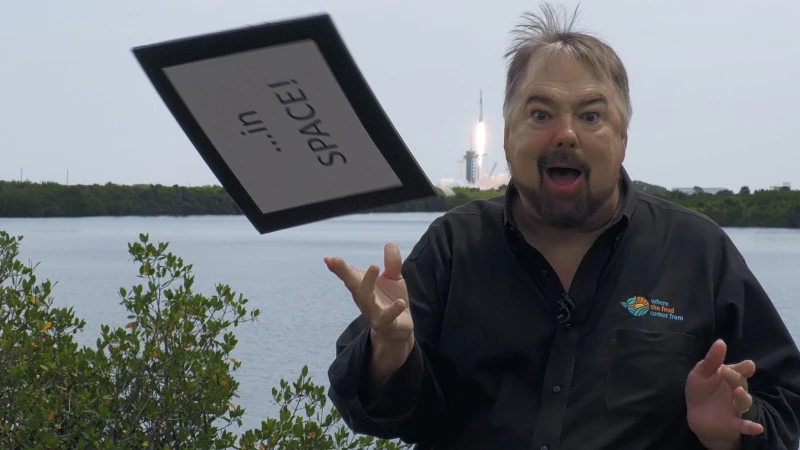
Credit: Where The Food Comes From
But wait a minute… let’s look at that film. And what we see is amazing! Chip’s body does indeed block the Falcon 9. As he goes to the cue cards, at the most-perfect moment the rocket rises over his right shoulder.
What are the chances?!? The host blows it and somehow it still works. My thought: There had to be a bit of divine intervention. Wouldn’t you agree?
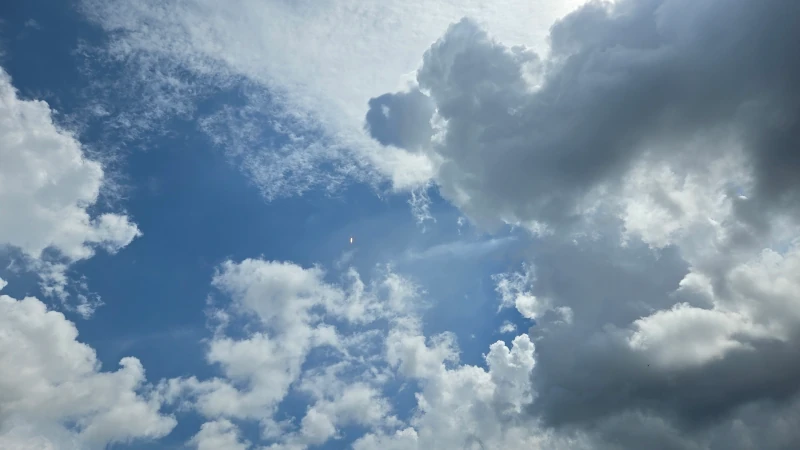
Falcon 9 soaring to space. Credit: Donna Sanders
I missed it all. Chip talks about how the ground rumbled and shook, and as he turned to face the rocket and witness the launch, he’s pretty sure he saw The Face of God.
I had a job to do. I didn’t see the smoke – in all its flaming glory – coming out of the bottom of the rocket, and the hold-down arm moving away, setting it free to soar into the sky. My heart was racing so bad watching and trying to cue Chip that I forgot to look. When I did finally gather my wits enough to look up, I saw a small streak of light that was Falcon 9 in the sky.
Yeah, I may have missed it all. But I didn’t “miss” any of it – I was, instead, part of it.
Standing with Dr. Vendrame, we are all still looking up at the sky in total and silent awe. The clouds have moved in and we’re unable to see the boosters separating. A sonic boom and another round of trembling earth tell us what’s happening. As the rocket boosters return and land on a waiting ship, I realize what’s been the opportunity of a lifetime for us is, in reality, just another two historic days on Cape Kennedy.
Our day is done. Our NASA mission is over – at least this one. At least for now.
To Be Continued…
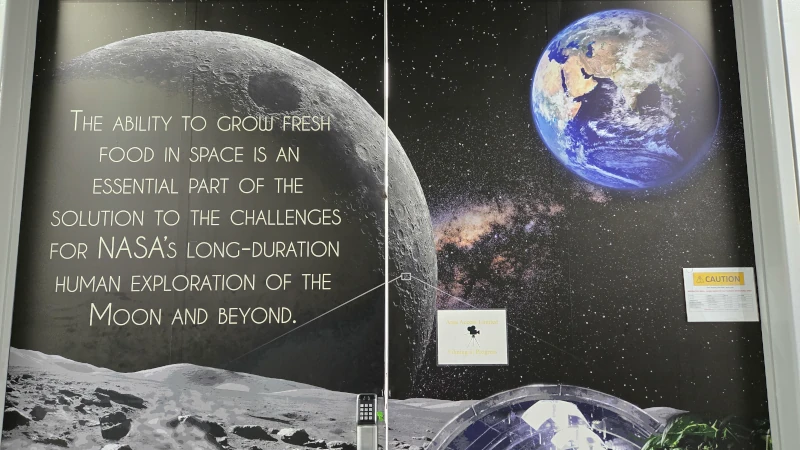
Featured Image: A laboratory door at Kennedy Space Center leads to the Space Crop Lab. Credit: Donna Sanders
About Donna Sanders
Donna Sanders is the Asst. Producer, Food Editor, and official photographer for the network TV, YouTube and National Ag In The Classroom show Where The Food Comes From. Her work can be seen on the WTFCF website and in periodicals throughout the U.S. Prior to joining WTFCF, Donna was a career nurse and nursing instructor in Tampa, Fl. In her free time she enjoys a good book, cooking, and her five grandchildren.