A ray of hope in the battle against citrus greening: Three bugs eat the eggs of the psyllid
Written by: Brad Buck, Senior Public Relations Specialist, UF/IFAS
A few tiny heroes may help fight Florida’s long-running battle against citrus greening disease. That’s good news for commercial growers as well as to residents who plant citrus trees in their yards at home, say University of Florida scientists.
Researchers with the UF Institute of Food and Agricultural Sciences (UF/IFAS) have found three commercially available insect species that devour the eggs of the Asian citrus psyllid, the notorious pest responsible for spreading Huanglongbing (HLB), the disease that has severely damaged the state’s citrus groves for two decades.

A Lacewing larvae eats the eggs of an Asian citrus psyllid. Credit: Romain Exilien, UF/IFAS
For growers who have watched orchards wither and yields collapse, the discovery feels like a rare bright spot. These natural predators could become an important new line of defense in a fight that has stretched on for years and cost billions. This is particularly true for organic growers who have limited options to control the psyllid, said Xavier Martini, a UF/IFAS associate professor of entomology.
Those who grow citrus at home also might deploy the predatory bugs to battle psyllids.
There’s still a journey ahead. Researchers need to see how these bugs perform outside the lab in real-world conditions.
In the past, scientists have tested the ability of predatory bugs to eat nymph and adult psyllids. This was the first experiment on psyllid eggs, Martini said.
Romain Exilien, a post-doctoral researcher at the North Florida Research and Education Center (NFREC), led the new study, supported with funding from the USDA National Institute of Food and Agriculture.
The research shows three of the four predatory bugs eat psyllid eggs at high rates.
Scientists studied the minute pirate bug, the green lacewing larva, a ladybeetle named mealybug destroyer and the predatory mite Amblyseius swirskii. All except Amblyseius swirskii significantly reduced the egg numbers.
Over two days, minute pirate bugs consumed 67 eggs, whereas lacewing larvae ate 111 and mealybug destroyer 153. At 93 and 97%, green lacewing and mealybug destroyer ate the most eggs.
Those statistics come as good news for citrus growers and homeowners.
“Homeowners are the main target here,” said Martini, who serves as Exilien’s supervisor at NFREC. “I am confident that our lab experiment will transfer pretty well to a single tree in a garden with minimal to no insecticide spray. Homeowners are interested in biological control of all bugs, but particularly psyllids.”
Jawwad Qureshi, an associate professor of entomology at the Southwest Florida Research and Education Center and a co-author on the current study, said growers will appreciate these findings.
“The findings on their egg consumption are encouraging,” Qureshi said. “These findings indicate that targeting Asian citrus psyllid eggs with lacewings or mealybug destroyers may substantially enhance sustainable psyllid management and support long-term HLB mitigation in citrus groves.”
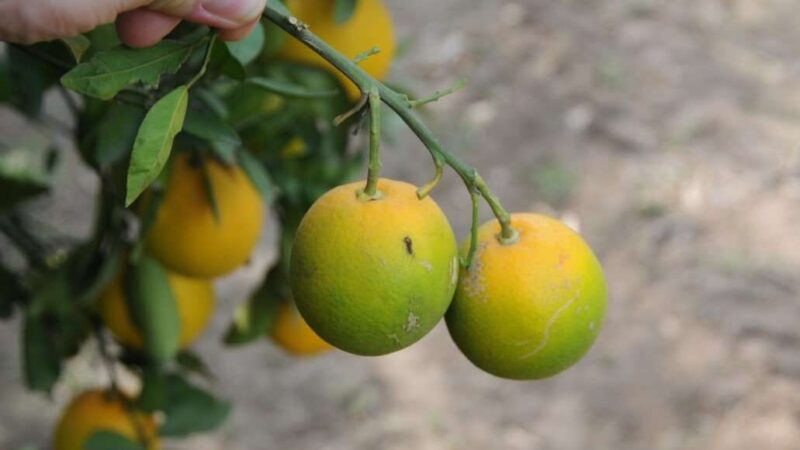
Feature Image: Oranges suffering from Huanglongbing (citrus greening). Credit: Where The Food Comes From
The post A ray of hope in the battle against citrus greening: Three bugs eat the eggs of the psyllid, written by Brad Buck, first appeared in the UF/IFAS News blog.
The mission of the University of Florida Institute of Food and Agricultural Sciences (UF/IFAS) is to develop knowledge relevant to agricultural, human and natural resources and to make that knowledge available to sustain and enhance the quality of human life. With more than a dozen research facilities, 67 county Extension offices, and award-winning students and faculty in the UF College of Agricultural and Life Sciences, UF/IFAS brings science-based solutions to the state’s agricultural and natural resources industries, and all Florida residents.