
Dr. Marion Nestle, longtime NYU professor of nutrition, food studies, and public health, with additional faculty roles at UC San Francisco and Cornell, is best known for analyzing the intersections of food, politics, and health, often exposing how government policy, corporate lobbying, and food industry marketing shape what we eat.
HHS issues new guidelines for food served in hospitals
Mehmet Oz’s Centers for Medicare & Medicaid Services (CMS) sent a memo to hospitals last week, telling them to align their food service policies and practices with the 2025–2030 dietary guidelines (see announcement in video).
Hospitals should:
- Limit ultra-processed food options for patients.
- Eliminate sugar-sweetened beverages unless clinically appropriate in limited scenarios.
- Eliminate refined grains and replace them with 100% whole grains.
- Prioritize minimally processed protein sources, including plant-based options.
- Emphasize vegetables, fruits, legumes, nuts, seeds, seafood, and healthy fats.
- Ensure baked, broiled, roasted, stir-fried, or grilled vegetables and proteins – and eliminate deep fried cooking methods.
- Eliminate processed meats and foods high in added sugars, sodium, and artificial additives.
- Ensure meals contain less than 10 grams of added sugar, unless clinically appropriate.
These sound terrific!
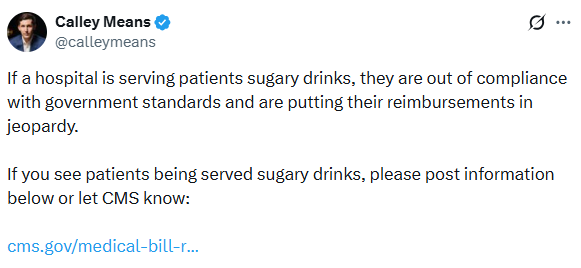
According to RFK Jr’s advisor, Calley Means, these guidelines will be enforced.
Hospital food, of course, has been criticized heavily for decades. A hospital director once explained to me that it was the only place in his budget that was discretionary, the only option he had for cutting spending, which he did.
But as always, the situation is complicated and the devil is in the details. Kevin Klatt, a nutrition professor in Toronto, questions on his Substack whether this is “anything more than the nutrition political theatre that we’ve come to expect from this federal administration/MAHA?”
He reviews the regulatory issues but also points out that clinical (hospital-based) nutrition is not the same as public health nutrition.
Patients who are acutely ill and hospitalized are not the general public that the DGAs are made for…Patients who are hospitalized often have conditions that impact their nutritional requirements, alter their ability to digest, absorb, and assimilate nutrients, and major barriers to consuming a normal diet – everything from altered taste and smell to the inability to chew and swallow…It’s clear no clinical dietitians…were in the room when this memo was put out…or it was always meant as more political performance before the midterms, as RJK Jr is being encouraged to quiet down on vaccines and play to his foodie base.
Yes, clinical dietitians must deal with their patients’ needs.
But surely these rules ought to apply to the hospital cafeterias and vending machines that serve visitors and staff. That alone would be a big step forward.
Here too, I can’t wait to see how it all plays out.
The post HHS issues new guidelines for food served in hospitals appeared first on Food Politics by Marion Nestle.
Marion Nestle is Paulette Goddard Professor of Nutrition, Food Studies, and Public Health, Emerita, at New York University, which she chaired from 1988-2003 and from which she officially retired in September 2017. She is also Visiting Professor of Nutritional Sciences at Cornell. She earned a Ph.D. in molecular biology and an M.P.H. in public health nutrition from the University of California, Berkeley, and has been awarded honorary degrees from Transylvania University in Kentucky (2012) and from the City University of New York’s Macaulay Honors College (2016). In 2023, she was awarded The Edinburgh Medal (for science and society).