Dr. Marion Nestle, longtime NYU professor of nutrition, food studies, and public health, with additional faculty roles at UC San Francisco and Cornell, is best known for analyzing the intersections of food, politics, and health, often exposing how government policy, corporate lobbying, and food industry marketing shape what we eat.
In this series, she examines the 2025–2030 Dietary Guidelines for America and their potential implications for nutrition and policy.
The MAHA 2025-2030 Dietary Guidelines have arrived: Cheerful, Muddled, Contradictory, Ideological, Retro
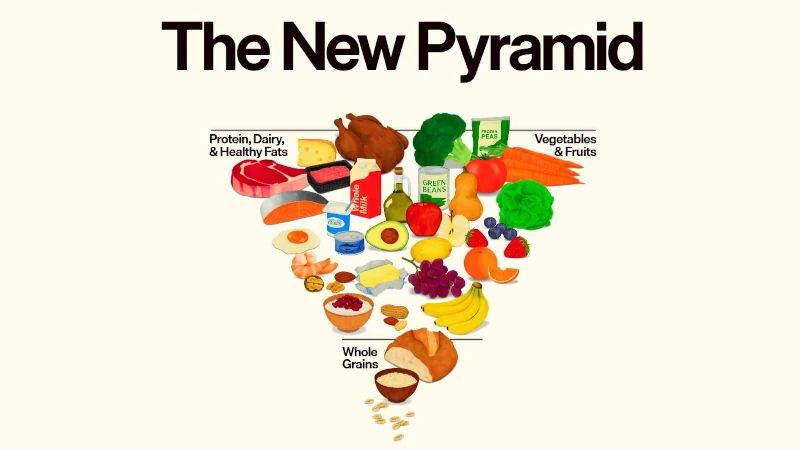
Credit: USDA
The new Dietary Guidelines [The guidelines are in bold; my summary follows]
- Eat the right amount for you: balance calories
- Prioritize protein foods at every meal: prioritize animal sources
- Consume dairy: prioritize full-fat
- Eat vegetables & fruits throughout the day: eat more, but not as much as previously recommended
- Incorporate healthy fats: prioritize animal fats
- Focus on whole grains: prioritize, but eat less than previously recommended
- Limit highly processed foods, added sugars, & refined carbohydrates: eat less
- Limit alcoholic beverages
These were released along with a fact sheet, scientific report, and interactive website. I’ve summarized the details below in a table comparing these guidelines to the previous version.
Why muddled? The lists of guidelines differ among the various documents. The prioritization of protein is hard to understand; most Americans already eat plenty. Some of the instructions don’t make sense: “Consume meat with no or limited added sugars?” Who does this?
Why contradictory? If you increase the amount of protein, meat, and full-fat dairy in your diet, you will not be able to keep your saturated fat intake below 10% of calories, and will have a harder time maintaining calorie balance (fat has twice the calories of protein or carbohydrate). If you want to increase the amount of fiber in your diet, you need to prioritize vegetables, fruits, and whole grains, not meat and dairy.
Why ideological? The fats recommended as sources of essential fatty acids—olive oil, butter, and beef tallow—have little or no essential linoleic or alpha-linolenic acids. For those, seed oils (not mentioned in these guidelines) are much better sources. The prioritization of animal-based as opposed to plant-based is inconsistent with research on diet and health. USDA Secretary Rollins said these guidelines would no longer reflect leftist ideology. The fact sheet and website make the ideology explicit.
Why retro? Except for the excellent advice to reduce intake of highly processed foods, which were not particularly prevalent back then, these guidelines take us back to the diets of the 1950s when everyone was eating lots of meat and dairy and not worrying much about vegetables, and heart disease was rampant. I’m all for eating whole foods but these guidelines dismiss 75 years of research favoring diets higher in plant foods.
Bottom line: A mixed bag. These guidelines are big wins for the meat, dairy, and alcohol industries (alas). The loser: ultra-processed foods (yes!). The recommendation to reduce highly processed foods (a euphemism for ultra-processed) is the one great strength of these recommendations. Following that advice might help Make America Healthy Again. But the rest must be viewed more as ideology than science, and also must be interpreted in the light of this administration’s destruction of what was once a reasonably effective public health service (CDC, FDA, NIH) and system. Eating more meat and fat is unlikely to help people resist measles and other illnesses preventable by vaccination.
I have more to say about the specific recommendations below. But first, here’s my quick summary.
Dietary Guidelines: 2020-2025 vs. 2025-2030
| RECOMMENDATION | 2020–2025 | 2025–2030 | CHANGE? |
|---|---|---|---|
| Number of pages | 149 | 10 | |
| Calories | Measure by weight status | Eat the right amount | Same |
| Water | Choose | Choose | Same, but stronger |
| Protein | 56 g/2000 kcal (based on 0.8 g/kg) | Prioritize at every meal (84–112 g/2000 kcal, based on 1.2–1.6 g/kg) | Increase |
| Dairy | 3 cups/day | 3 servings | Same |
| Vegetables | 2.5 cups/day | 3 servings/day | Decrease |
| Fruits | 2 cups/day | 2 servings/day | Decrease |
| Fats | 27 grams/day oils | Healthy | Prioritize animal sources |
| Saturated fat | <10% calories | <10% calories | Same |
| Grains | 6 ounces, >3 whole/day | 2–4 servings/day | Decrease, prioritize whole |
| Processed foods other than meat | Not mentioned | Limit, avoid | Major improvement |
| Added sugars | Eat less | Limit, avoid | Stronger |
| Sodium | <2300 mg/day | <2300 mg/day | Same |
| Alcohol | <2 drinks/day for men; 1 for women | Limit, consume less | Weaker |
| Eat more | Vegetables, fruits, legumes, whole grains, low- or non-fat dairy, lean meats, poultry, seafood, nuts, unsaturated vegetable oils |
Animal-source foods, full-fat dairy, vegetables, fruits, healthy fats, butter, beef tallow, whole grains |
|
| Eat less | Red and processed meats, sugar-sweetened foods and beverages, refined grains, alcohol | Added sugars, refined grains, chemical additives, fruit and vegetable juices, highly processed foods and beverages, sodium, alcohol |
|
| Dietary sustainability | Not mentioned | Not mentioned | Same, alas |
Stay tuned.
The MAHA Dietary Guidelines II: Personal Responsibility vs. Public Health Policy
Above, I gave an overview of the guidelines, finding them cheerful, but muddled, contradictory, ideological, and retro.
I do like the cheerful message: Eat Real Food.
But after reviewing lsome of the rest of the materials that come with the guidelines, I think those terms miss a more important concern: they are about personal responsibility, not public health.
This is most explicit from the Eat Real Food Website.
Our nation is finding its footing again, moving past decades of unhealthy eating and rebuilding a food culture rooted in health, science, transparency, and personal responsibility.
In March, I posted a a comment about a statement made by USDA Secretary Brooke Rollins.
Secretary [of HHS] Kennedy and I have a powerful, complementary role in this, and it starts with updating federal dietary guidance. We will make certain the 2025-2030 Guidelines are based on sound science, not political science. Gone are the days where leftist ideologies guide public policy.
I could not imagine how anyone could think the dietary guidelines reflected leftist ideology and guessed that she must have been talking about plant- as opposed to meat-based diets. I wasn’t entirely wrong. Eating meat is the first priority of the guidelines, a matter I will discuss next week.
But now I think she must have meant personal responsibility as opposed to public health policy.
This approach leaves it entirely up to you to make healthful food choices, never mind that if you try to eat healthfully, you are fighting the entire food system on your own.
The goal of food companies—even those selling real food—is to get you to buy as much of it as possible, regardless of how their products affect your health or that of the planet.
Given this administration’s destruction of the public health system in America, you really are on your own.
The groups in America who eat most healthfully are educated; have decent jobs, money, and resources; have homes with functioning kitchens; can cook; live in safe neighborhoods with grocery stores; and have access to affordable health care. That’s what public health is about.
If the government leaves it to you to “do your own research” and fight the food system on your own, it is saying it has no responsibility for creating a food environment that can help you eat and enjoy real food.
It’s all on you.
The eat-real-food message is cheery and for sure it’s how I eat, at least most of the time. I will have more to say about it next week too.
But the focus on personal responsibility troubles me. Shouldn’t all of us be able to eat as healthfully as possible?
The Fact Sheet rejects health equity out of hand, but then says:
We reject this logic: a common-sense, science-driven document is essential to begin a conversation about how our culture and food procurement programs must change to enable Americans to access affordable, healthy, real food.
Isn’t that what health equity is about? For that we need policy backed by resources. Personal responsibility won’t work without it.
The MAHA Dietary Guidelines III: Conflicts of Interest
On Mondays, I typically post something about industry-funded research or investigator conflicts of interest.
In the light of Robert F. Kennedy’s complaints about conflicts of interest in previous dietary guidelines advisory committees, it is startling to observe the industry ties reported by members of this administration’s committee.
These conflicted interests are also surprising in light of the high prioritization of meat in these guidelines, which advise eating protein (a commonly understood euphemism for meat) in every meal, and high-fat dairy.
The committee’s membership and disclosures are given on pages ix-xviii of the Scientific Foundation report.
To focus just on ties to meat and dairy groups, members report financial ties to
- Global Dairy Platform
- Nutricia/Danone
- National Cattlemen’s Beef Association
- Texas Beef Council
- American Dairy Science Association
- National Dairy Council
- National Pork Board
- California Dairy Innovation Center
- Fonterra Limited
- California Dairy Research Foundation
- Dairy Management Inc
This was reported originally in Stat News (which quotes me elsewhere in the story).
It’s unclear how the Trump administration appointed its group of nutrition scientists and other researchers. A scientific report linked at the bottom of a new federal website, RealFood.gov, says only they were chosen through “a federal contracting process based on demonstrated expertise.”
The Times quotes Mark Kennedy, the senior vice president of legal affairs for the Physicians Committee for Responsible Medicine, which supports plant-based diets and has filed a complaint with the government saying it should withdraw the guidelines.
Disclosing conflicts of interest at the end of the process “isn’t really going to cut it..Because if nobody ever had a chance to weigh in, and nobody other than the government behind closed doors had a way to assess it, there’s no way to ensure there’s fair balance.” (Mr. Kennedy is not related to the health secretary.)
Comment
In reading through press accounts, I’m pretty sure I saw one where one of the committee members reporting financial ties tossed it off with some comment about how he was sticking to the science and that’s all that mattered (I’ve searched but can’t find it now).
I heard that a lot after publication of my book, Unsavory Truth: How Food Companies Skew the Science of What We Eat. In that book, I review research on the “funding effect,” the strong correlations between who pays for food and nutrition research and its outcome. Industry-funded research tends to produce results favorable to the funder’s interests (otherwise it wouldn’t be funded). But recipients of funding typically did not intend to be influenced and do not recognize the influence. It is not surprising that this committee—unlike many other scientific committees over the past decades—came to precisely the conclusions decided in advance by Secretaries Kennedy and Rollins.
The MAHA Dietary Guidelines IV: Eat more meat!
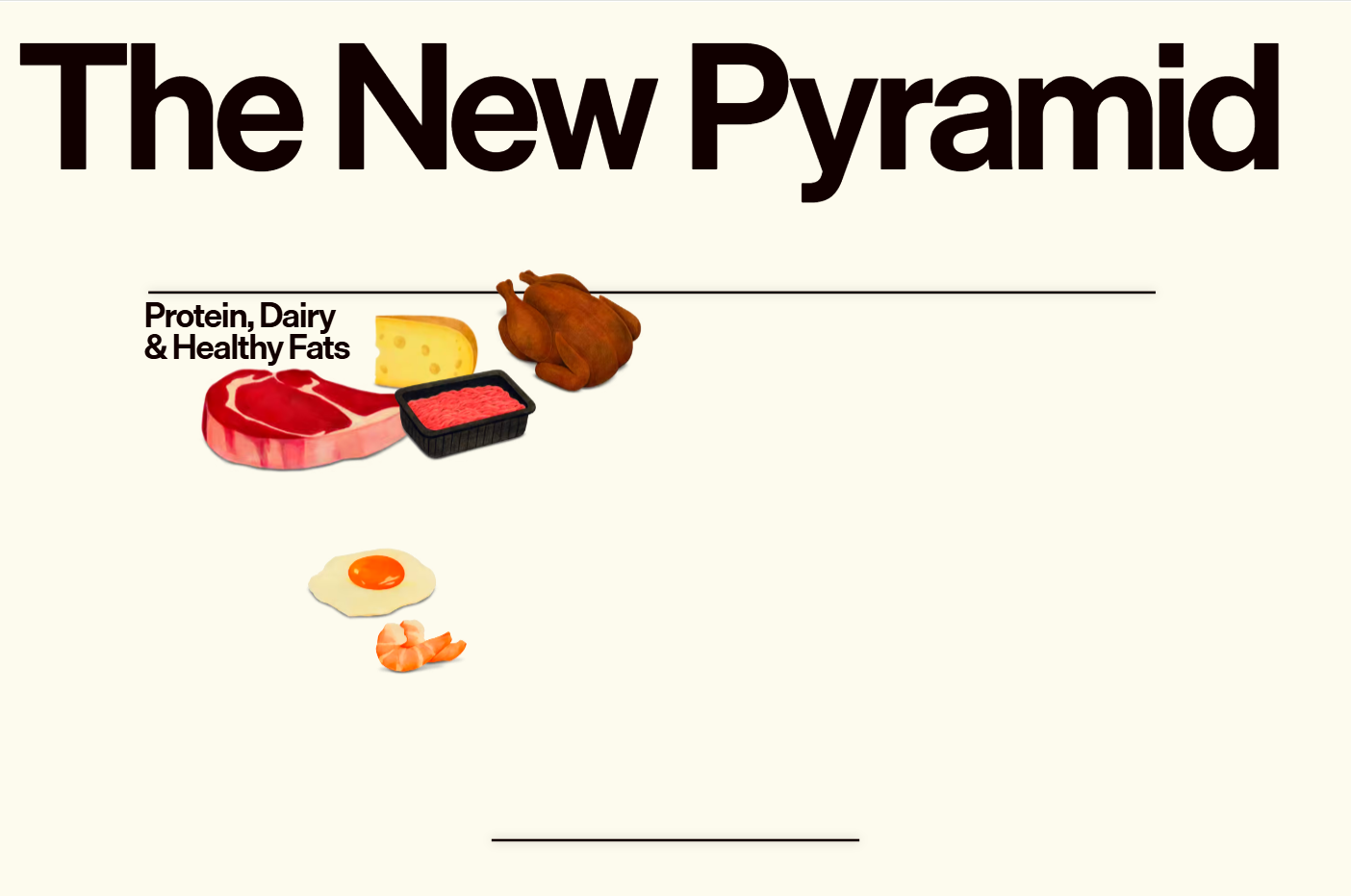
The Eat Real Food Website says “We are ending the war on protein. Every meal must prioritize high-quality, nutrient-dense protein from both animal and plant sources….” But here’s what comes up first and is clearly the first priority.
And here’s an exultant RFK Jr on X:
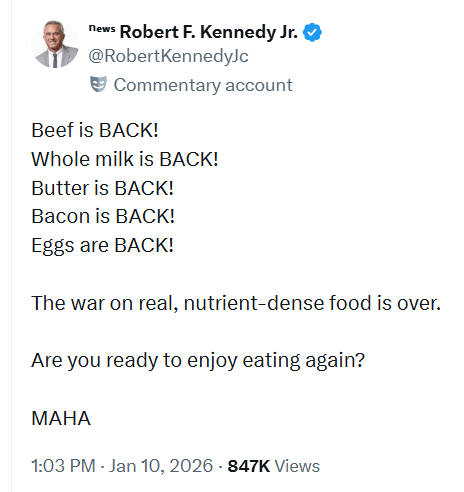
Protein is well understood to be a euphemism for meat. I’ve already written about how most people already eat twice the protein needed so advice to eat more of it is unlikely to do anyone any good.
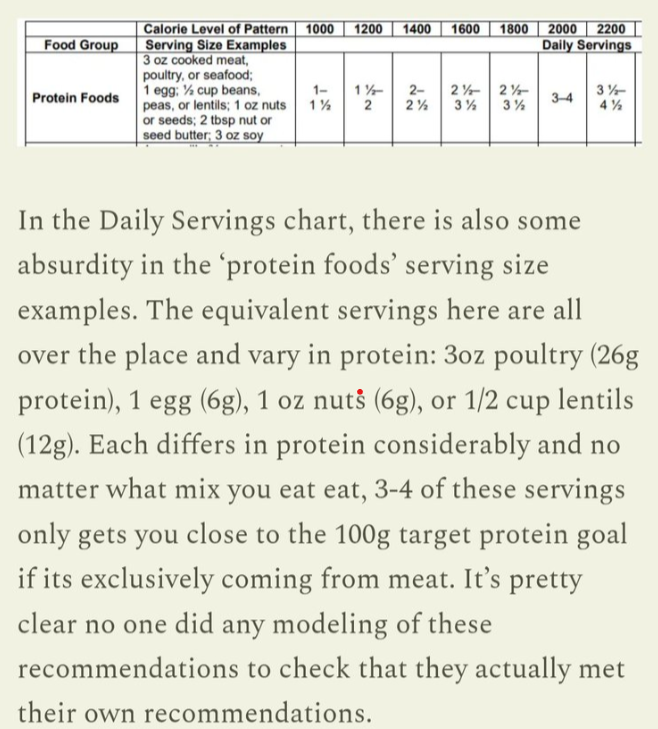
And the document, Daily Servings by Calorie Level, makes it clear that you have to eat meat if you are going to reach the level of protein intake recommended. For this, I am indebted to Kevin Klatt, who posted this on X.
What’s wrong with recommending more meat?
- It’s healthier getting protein from plant sources.
- The way we produce meat pollutes the environment with pesticides and herbicides to grow their feed.
- It also presents major food safety hazards (see Eric Schlosser’s update on Fast Food Nation)
- Cattle burp methane and are the single largest food source of greenhouse gas emissions.
- Beef cattle are raised in CAFOs under crowded and dirty conditions.
- The meat industry exploits workers.
- Consolidation in the meat industry keeps prices high (Tyson’s just agreed to an $82.5M settlement in a beef price-fixing lawsuit)
- Producing meat the way we do is not sustainable and adds to inequities.
Of course, sustainability and equity are non-topics for this administration. But they matter and should very much be on the table for discussion.
We already eat plenty of meat—more than 100 pounds per capita per year of red meat alone (according to USDA). We don’t need to be eating more.
Correction
In my first post on these dietary guidelines, I said:
Some of the instructions don’t make sense: “Consume meat with no or limited added sugars?” Who does this?
Several readers wrote to object. Renata M, for example, said she could think of so many examples, she just had to say something.
- BBQ sauce
- Ketchup
- Teriyaki sauce
- Other popular “Chinese” foods
- Brown sugar-glazed pork chops
- Pasta sauce
- Sloppy Joe’s
- Brines and marinades
- and more, if honey and maple syrup are considered added sugars [they are]
Oops. Sorry about that. Thanks!
The MAHA Dietary Guidelines series appeared first on Food Politics by Marion Nestle.
- Part I: Cheerful, Muddled, Contradictory, Ideological, Retro
- Part II: Personal Responsibility vs. Public Health Policy
- Part III: Conflicts of Interest
- Part IV: Eat more meat!
Marion Nestle is Paulette Goddard Professor of Nutrition, Food Studies, and Public Health, Emerita, at New York University, which she chaired from 1988-2003 and from which she officially retired in September 2017. She is also Visiting Professor of Nutritional Sciences at Cornell. She earned a Ph.D. in molecular biology and an M.P.H. in public health nutrition from the University of California, Berkeley, and has been awarded honorary degrees from Transylvania University in Kentucky (2012) and from the City University of New York’s Macaulay Honors College (2016). In 2023, she was awarded The Edinburgh Medal (for science and society).