95% of U.S. Farms Are Family-Owned, Drives 80% of U.S. Agricultural Output
A new study on behalf of Farm Flavor has identified the states with the most family-owned farms.
Now more than ever, people want to know where their food comes from. National conversations often center on “Big Ag” and corporate takeover of the food sector, but the latest USDA Census of Agriculture shows a more nuanced reality on the ground: most American farms are still run by families. Nearly 95% of U.S. farms are family-owned, and a large majority are small operations with modest annual revenue. Across the U.S., family farms anchor local economies, preserve working lands and sustain community food systems – and in many states, capture the biggest share of sales.
With this in mind, our researchers here at Farm Flavor analyzed the latest USDA data to understand how many U.S. farms are family-owned, how much they produce and which states rely most on family-run farms.
Key Findings
- Family farms power American agriculture. The U.S. is home to roughly 1.8 million family farms, which collectively generate about $484 billion in agricultural output each year.
- Family ownership dominates. 94.7% of all U.S. farms are family-owned, and these operations are responsible for more than four out of every five dollars (80.7%) in total farm sales nationwide.
- Small but numerous. Of the 1.8 million family farms, about 1.6 million are small family operations earning less than $350,000 annually. The average family-owned farm generates about $269,000 in agricultural sales each year.
- Family reliance is universal. In every state, at least 90% of farms are family-owned, with states such as West Virginia (97.6%), Tennessee (97.5%) and Kentucky (96.8%) leading the nation.
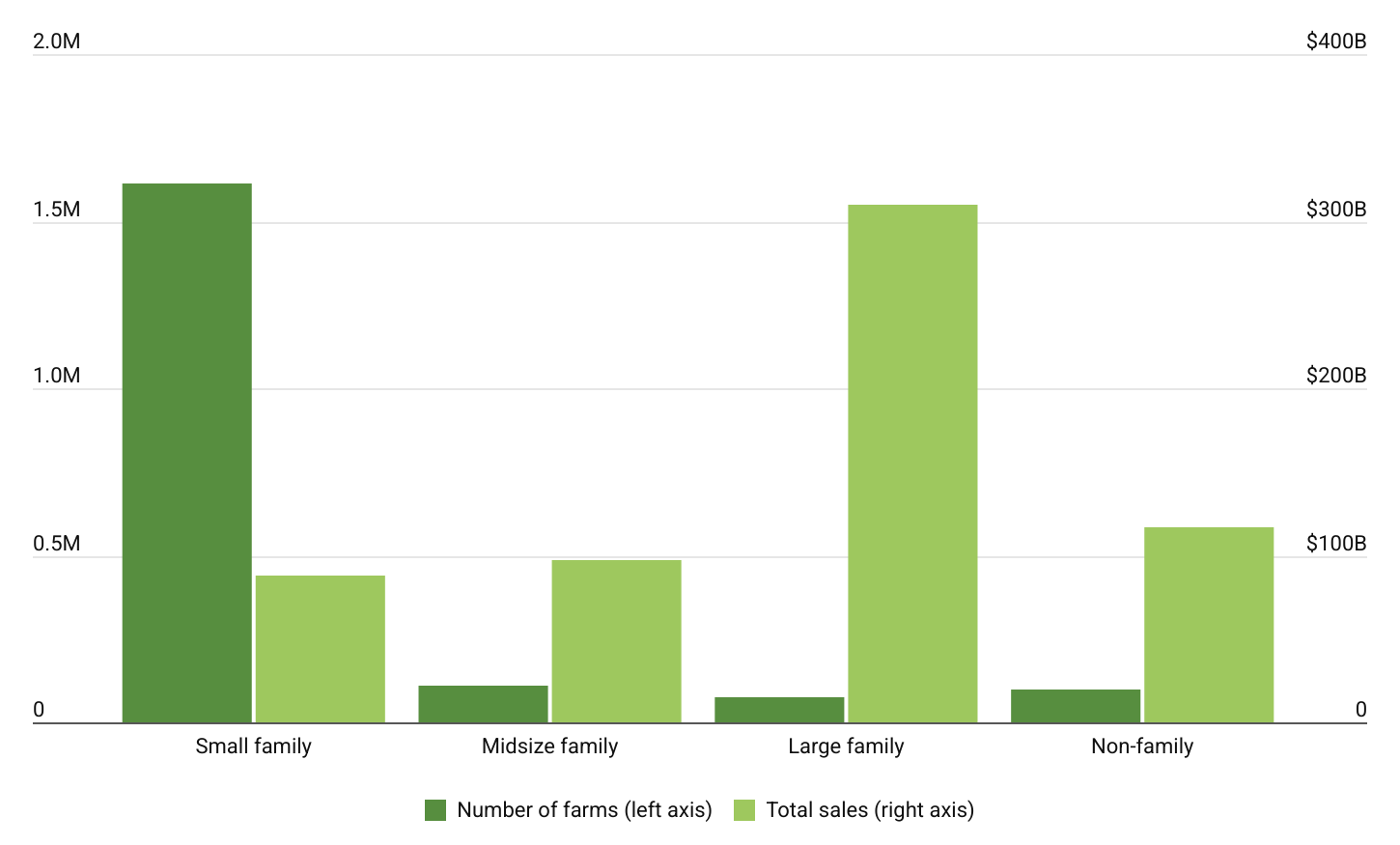
U.S. Family Farms & Sales by Type
Farm Flavor analysis of USDA data.
Family farms are the foundation of American agriculture. According to USDA, a family farm is one in which the majority of the business is owned by the principal operator and individuals related to them. Encompassing everything from small, sole proprietorships to large corporate-structured operations driving industry consolidation, family operations make up 94.7% of all U.S. farms and are responsible for 80.7% of total agricultural output – a striking reminder that America’s food system remains overwhelmingly family-run.
Together, small and midsize family farms – those with less than $1 million in annual gross income – account for 90.8% of farms and nearly one-third (30.2%) of total agricultural output. These farms are vital to rural economies, providing local employment and sustaining communities across every region of the country.
Credit: ©Journal Communications/Karen Pulfer Focht
At the same time, large family farms – those earning $1 million or more annually – represent a much smaller share of total farms but contribute over half (50.6%) of the nation’s agricultural output. These larger family operations reflect the increasing efficiency and scale of modern production agriculture, especially in commodity crop and livestock sectors.
Farms not owned by the principal operator and his or her family make up only about 5% of all farms and contribute 19.1% of agricultural output. Altogether, these figures underscore that American agriculture remains overwhelmingly a family-run enterprise – from small, diversified farms to large, multi-generational operations.
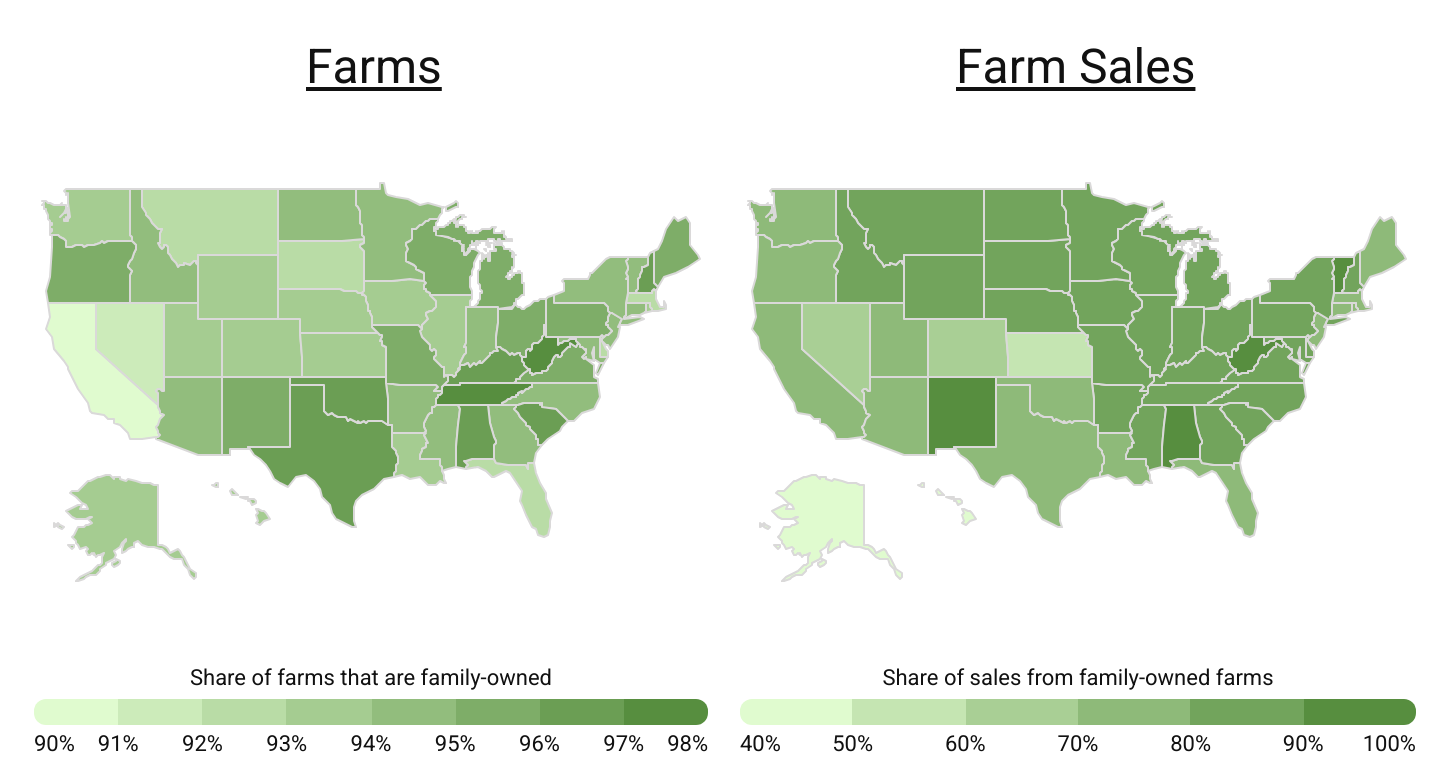
States That Rely Most on Family-Owned Farms
Farm Flavor analysis of USDA data
Family ownership is the overwhelming norm in American agriculture, but the extent to which states rely on family-run farms – and the share of agricultural output they produce – differs significantly across the country. The share of farms that are family-owned ranges from about 90% to 98%, while the share of total agricultural output generated by those farms varies much more widely, from roughly 47% in some states to more than 93% in others.
Broadly, family farm ownership is highest in the Appalachian, Southern and Midwest regions, where agriculture tends to remain local, generational and community-driven. States such as West Virginia (97.6%), Tennessee (97.5%) and Kentucky (96.8%) lead the nation in family-farm ownership, and their output shares closely mirror these figures – 93.3%, 89.0% and 88.1%, respectively. In much of the Southeast and Midwest, the same pattern holds.
Still, there are some notable outliers where the connection between family ownership and sales is weaker. Texas and Oklahoma, for example, each have around 96% of farms classified as family-owned, yet only 70.2% and 73.5% of farm sales come from those operations. Similarly, Maine shows a significant gap, with 95.4% of farms family-owned but just 71.6% of sales attributed to them. Alaska and Hawaii stand out as the only two states where family farms account for less than 50% of total agricultural output.
These discrepancies suggest that while family ownership is nearly universal, non-family operations are disproportionately more productive in certain regions due to either scale or specialization in high-value commodities. Below is a comprehensive breakdown of family-owned farm data for all 50 states, including the number of farms and total sales by farm type.
Here are the statistics for the entire United States:
- Share of farms that are family-owned: 94.7%
- Share of sales from family-owned farms: 80.7%
- Family-owned farms: 1,800,363
- Total farms: 1,900,487
- Family-owned farm sales: $484,439,894,072
- Total farm sales: $599,995,091,745
- Average family-owned farm sales: $269,079
The post The Heart of American Farming: States With the Most Family-Owned Farms, written by by , first appeared on FarmFlavor.com.
Methodology
The data in this analysis comes from the USDA 2022 Census of Agriculture (the most recent release). To identify the states with the most family-owned farms, researchers calculated the share of farms in each state that meet the USDA’s definition of a family farm, meaning the majority of the business is owned by the principal operator and individuals related to them by blood, marriage or adoption. The analysis also compared agricultural output – measured as the market value of products sold – across different farm types, including small, midsize and large family operations as well as non-family farms. All dollar figures were inflation-adjusted to 2025 values using data from the U.S. Bureau of Labor Statistics Consumer Price Index.
About Farm Flavor
Farm Flavor profiles America’s hardworking farmers and ranchers who produce our food, fuel and fiber, connecting consumers to the country’s vital agriculture industry. Find information on exactly where our food comes from, along with delicious recipes, helpful tips and reliable data.