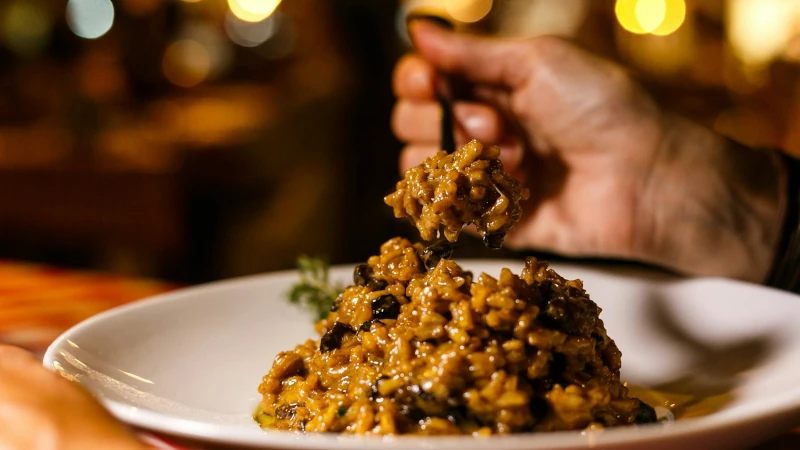
If you have ever looked at a menu and wondered why risotto gets its own special section separate from ordinary rice dishes, you are not alone.
While rice is the star ingredient, risotto is a cooking method, not a type of grain. Here is everything you need to know about this velvety Italian classic.
The Starch Secret
You cannot make risotto with just any bag of rice from your pantry. It requires specific, high-starch, short-grain Italian varieties like Arborio or Carnaroli.
Unlike long-grain rice (like Basmati or Jasmine) which cooks up light and fluffy, these short grains pack a massive amount of surface starch. This starch is the secret weapon behind risotto’s signature texture.
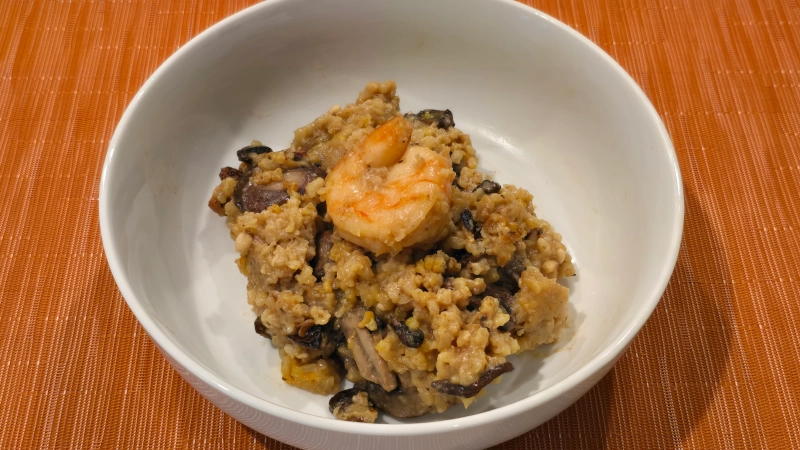
A delicious bowl of Mushroom and Giant Shrimp Risotto made by Where The Food Comes From Producer and Host Chip Carter. (And yes, he definitely used shallots!)
A Note from the Where The Food Comes From Kitchen: “I’d heard of risotto of course, when I first went to Italy in the 1990s — like most Americans, I thought of it as something like a rice pilaf. Whoops. I was in Venice, ordered it on a whim. Went back the next night to get it again; stuck around until the chef agreed to tell me how to make it. Perfect risotto is one of those dishes that is so much more than the sum of its parts — put together and handled right, it’s transformative. It’s more time-consuming than difficult, but there are a lot of moving parts and little room for error.
When you finish a perfect risotto, you feel like you just ran a race — and that maybe you want to go lie down while your guests eat. Don’t. And don’t ever skip shallots as part of your base. You can have everything else, do it perfectly, and it’ll be delicious. But add minced shallots to your pan at the start and your guests will be looking at you like you should be cooking on TV.”— Chip Carter, Producer & Host, Where The Food Comes From
The Risotto “Low and Slow” Method
To make a standard pot of rice, you simply boil water, dump in the grains, cover it, and walk away. Risotto demands your full attention, a gentle simmer, and patience.
Why do chefs call it “low and slow”?
- Controlled Heat: You cannot rush risotto by blasting the heat. The broth must be simmered gently so the rice cooks evenly without burning or drying out.
- Gradual Process: Unlike regular rice where you dump all the water in at once, risotto requires adding hot liquid slowly, one ladle at a time.
- Time and Patience: It emphasizes that the dish takes active time and attention, about 20 to 30 minutes of standing at the stove, rather than being a quick, hands-off side dish.
The Culinary Ritual
Because of this technique, the actual cooking process becomes a beautiful, methodical ritual:
- The Toast (Tostatura): The dry rice is toasted in hot butter or olive oil to coat the grains and lock in their shape.
- The Deglaze: A splash of white wine is added and completely absorbed over medium heat to build a flavor base.
- The Ladle Routine: Hot broth is kept at a low simmer on the back burner and added one ladle at a time. You must stir the pot constantly, allowing the rice to drink up the liquid slowly before adding the next scoop. Rushing the heat or the liquid will ruin the texture.
Why All the Stirring?
Constant stirring rubs the rice grains together. This friction coaxes the starches out of the rice and into the broth, creating a rich, luxurious, and velvety sauce without needing to add heavy cream.
The final dish should be all’onda (wavy), so fluid enough to ripple across your plate, with grains that are perfectly al dente (firm to the bite).
References
- BBC Good Food. (2022). How to make risotto. BBC Good Food Video Technique Guide.
- Lopez-Alt, J. K. (2025). Classic Risotto al Parmigiano Recipe. Serious Eats.
- Prakash, S. (2025). Creamy Risotto Recipe (Our Best Recipe with Parmesan). The Kitchn.