Written by: Meredith Bauer-Mitchell
Highlights:
- Citizen science lets anyone collect real research data using a phone or notepad, contributing to peer-reviewed studies on wildlife, water and ecosystems.
- UF/IFAS uses data from apps like iNaturalist, IveGot1 and eBird to monitor invasive species and support conservation decisions.
- Volunteer participation powers major research efforts and events, including BioBlitzes, the City Nature Challenge, manatee sightings and seagrass monitoring.
Have you ever wanted to be a scientist? You still can be – and you can do it today with just your phone or a notepad.
Citizen science is a method of scientific data collection where community volunteers gather observations, photos and other metrics about the world around them. This crowdsourced data is then used in peer-reviewed studies, expanding what data scientists would otherwise have available for their research. With Earth Day just around the corner and April being Citizen Science Month, it’s never been a better time to get involved with collecting data on the natural world around you.
Ultimately, citizen science not only helps scientists get more data to use, but it helps demystify the scientific method for the public and gives them a way to participate in the process, said Corey Callahan, UF/IFAS assistant professor at the Fort Lauderdale Research and Education Center (FLREC).
“No matter the science background, there is scope for someone to get involved,” he said. “You can be a college student in a humanities field, an adult who’s never set foot in a lab, or even a young kid, but you can still participate as a scientist through citizen science.”
Citizen science works like this: Volunteers attend an event or do observations through a specific research initiative on their own, and they will collect observations based on the research goal. For example, to participate in the Florida Springs Heartland Manatee Sighting Network, individuals collect data on manatee sightings in the Suwannee, Santa Fe and Ichetucknee rivers and their connected springs. Citizen scientists record the time, date and location on a map of where they saw a manatee.
One of the areas where citizen science speaks volumes is with spotting species that scientists should keep an eye on, said Brent Sellers, UF/IFAS agronomy professor.
“Citizens can help us monitor new invasive species or endangered species,” he said. “This is something that we cannot often do alone.”
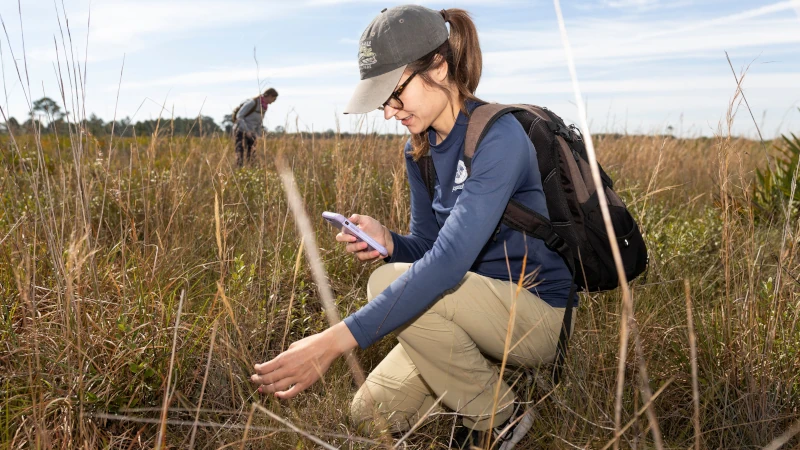
A volunteer identifying plant species with the with the iNaturalist phone app at DeLuca Preserve during the annual citizen science BioBlitz event. Credit: Tyler Jones, UF/IFAS
Citizen science has proven invaluable for invasive species spotting – data used for management and eradication of these species, which destroy a native ecosystem by eating native species or out-competing them for food.
The website and app IveGot1 allows anyone to log when and where they’ve spotted an invasive or non-native species, such as a Burmese python or Peters rock agama, and how many. The real-time data collection helps scientists and public land managers understand the spread of invasive species, so they can make more informed decisions.
Another frequently used citizen science app is iNaturalist, where anyone can log photos of plants, animals, fungi and other species. The app suggests what the observation might be of, including which type of animal or plant, and logs the location on a map.
Callahan’s research group often uses apps like iNaturalist, including for UF/IFAS citizen science events like the DeLuca Preserve BioBlitz, a 24-hour annual event where volunteers photograph as many species as possible in the Okeechobee preserve. At this year’s event in March, 140 participants recorded 12,485 observations and documented 1,529 species.
“Research really works through ‘people power.’ We couldn’t do all the studies we want to do, and thus make all the discoveries we’ve made, if it weren’t for the hours and hours of work put in through citizen science,” Callahan said.
Additional citizen science apps and websites Florida residents can use include:
- eBird: Share sightings of birds by logging photos and locations of bird species. This data is used for conservation decisions and peer-reviewed papers, according to the service.
- Nest Watch: Record spottings of nests and eggs and record changes in the baby birds over time.
- Frog Watch USA: This citizen science program records breeding calls of frogs and toads nationally.
- SpringsWatch: This program provides volunteers hands-on training at Florida springs to train them on water quality monitoring and wildlife and plant identification.
- Florida LAKEWATCH: This is a UF/IFAS volunteer lake monitoring program where citizen scientists collect data on fish, water conditions, nutrient levels, water clarity and more. So far, about two million data points have been collected since it began in 1986.
UF is part of multiple additional citizen science events each year, including:
- UF/IFAS Extension and Florida Sea Grant will support the Eyes on Seagrass Blitz from May 1 to May 30 at the Indian River Lagoon. Participants will spot species of seagrass – or the absence of seagrass – from a boat or kayak from Volusia, Brevard, Indian River, St. Lucie and Martin counties.
- Several UF/IFAS Extension offices will participate in the City Nature Challenge, where community members observe as many species as possible from April 24 to April 27. Some county offices that have participated in past challenges include UF/IFAS Extension offices in Polk, Alachua, Lee, Broward, Miami-Dade and Palm Beach counties..
Contact your local UF/IFAS Extension office to learn about how you can get involved in citizen science opportunities in your area.
The post Everyone can make a difference this Earth Day through citizen science, written by Meredith Bauer-Mitchell, first appeared in the University of Florida Newsroom.
The mission of the University of Florida Institute of Food and Agricultural Sciences (UF/IFAS) is to develop knowledge relevant to agricultural, human and natural resources and to make that knowledge available to sustain and enhance the quality of human life. With more than a dozen research facilities, 67 county Extension offices, and award-winning students and faculty in the UF College of Agricultural and Life Sciences, UF/IFAS brings science-based solutions to the state’s agricultural and natural resources industries, and all Florida residents.