
One-Button Foodborne Illness Testing for Anyone
KIMM develops Korea’s first fully automated rapid diagnostic system capable of detecting 16 foodborne pathogens by integrating separation, pre-treatment, and molecular diagnostics
Editor’s Key Takeaways
- A major leap in food safety testing: KIMM’s platform reduces foodborne pathogen detection time from days to just one hour, enabling faster response and prevention.
- True one-button automation: The system integrates separation, pre-treatment, amplification, and analysis into a single, fully automated workflow usable by non-experts.
- Designed for real-world use: Field-deployable and validated on multiple food categories, the technology is built for on-site testing in food production, catering, and government settings.
- Broad pathogen coverage: The platform simultaneously detects all 16 major foodborne pathogens specified by Korea’s food safety guidelines.
- Commercial and public health potential: With successful demonstration trials completed, the system shows strong promise for large-scale deployment and commercialization.
Korea’s first fully automated diagnostic system capable of simultaneously detecting 16 major foodborne pathogens within one hour has been successfully developed. Compared to conventional testing methods, the detection time has been reduced by more than half. Without complex experimental procedures, the system enables fully automated diagnosis with a single button press, and is expected to significantly enhance the level of food safety management. Designed for ease of use by non-experts in on-site environments, the technology is anticipated to strengthen foodborne illness prevention and response systems across the food industry.
A research team led by Senior Researcher Chanyong Park, Principal Researcher Dongkyu Lee, and Postdoctoral Researcher Changha Woo at the Department of Diagnostic Sensors, Daegu-Gyeongbuk Convergence Research Division, Korea Institute of Machinery and Materials (KIMM, President Seog-Hyeon Ryu)—under the National Research Council of Science & Technology (NST, Chairman Young-Shik Kim)—has developed a rapid, fully automated, field-deployable integrated system for foodborne pathogen diagnostics. The system integrates food matrix dissociation, nucleic acid pre-treatment, and molecular diagnostics into a single platform, automatically performing the entire workflow—from pathogen separation and nucleic acid purification to amplification and detection—within one device.
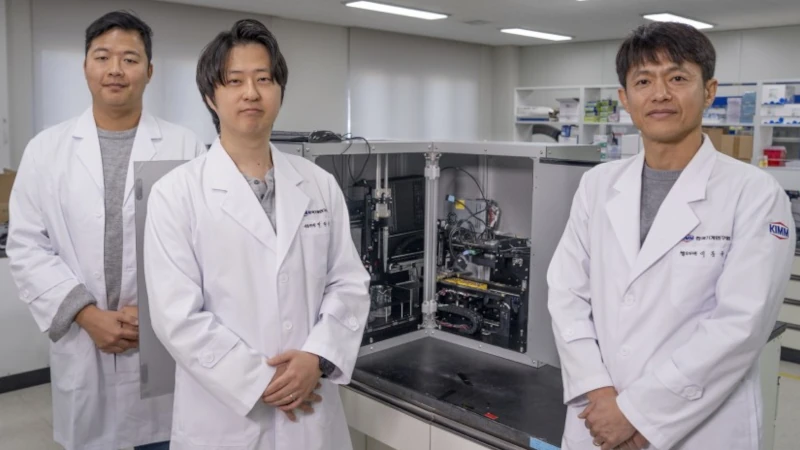
(R-L) Dongkyu Lee, Head of the Diagnostic Sensor Research Laboratory, Chanyong Park, Senior Researcher, and Changha Woo, Postdoctoral Researcher, at the Korea Institute of Machinery and Materials (KIMM). Credit: Korea Institute of Machinery and Materials (KIMM)
Conventional gold-standard methods for foodborne pathogen testing rely on culture-based identification, typically requiring at least two days and up to one week. While molecular diagnostic techniques have been partially introduced, their application in the field has been limited due to the need for specialized analytical equipment and highly trained personnel.
In contrast, KIMM’s system fully automates the entire process—including separation, pre-treatment, nucleic acid amplification, and result interpretation—within a single modular platform, enabling pathogen detection within one hour without the need for specialized expertise. The system first selectively isolates foodborne pathogens without damaging the food matrix by leveraging hydrodynamic forces generated by high-speed propeller rotation. Debris are then removed through a vacuum filtration process using multi-layer separation membranes, allowing rapid and efficient processing of large-volume samples (over 200 mL).
Purified nucleic acids undergo molecular diagnostics based on high-speed mechanical control, completing 40 cycles of thermal amplification within 15 minutes. In addition, the system employs proprietary reagents capable of detecting two or more fluorescent signals simultaneously within a single well, combined with a low-cost CMOS-based multi-fluorescence sensor. This configuration enables highly sensitive, simultaneous detection of all 16 foodborne pathogens specified in the guidelines of Korea’s Ministry of Food and Drug Safety (MFDS).
All procedures are operated through a fully automated, one-button process supported by integrated data analysis software, ensuring high usability and reliability even for non-expert users in on-site environments. The system is therefore expected to make a substantial contribution to food safety management.
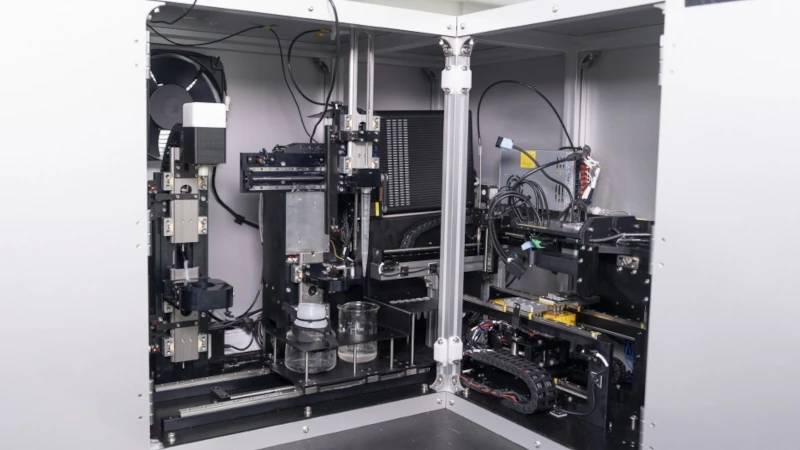
A high speed fully automated diagnostic system for detecting 16 foodborne pathogens has been developed by the Department of Diagnostic Sensors at the KIMM. Credit: Korea Institute of Machinery and Materials (KIMM)
The developed system is currently undergoing validation tests at two demonstration sites, covering more than four different categories of food products. Across all demonstration trials, both on-site applicability and analytical accuracy have been successfully verified. In particular, the system has shown significant improvements in processing time compared to existing methods, indicating strong potential for practical deployment and commercialization.
Senior Researcher Chanyong Park stated, “The greatest strength of this system lies in its ability to rapidly and accurately detect foodborne pathogens on site, while remaining easy to use even for non-experts.” He added, “If deployed in school and industrial catering facilities, food manufacturing sites, and local government food testing centers, the system is expected to play a critical role in preventing foodborne illness incidents in advance and significantly enhancing food safety.”
Principal Researcher Dongkyu Lee emphasized, “This technology—automating every step from separation to nucleic acid purification and molecular diagnostics within a single device—represents an innovative achievement that introduces a new paradigm in Korea’s food safety management framework.”
This field-deployable, high-speed, fully automated integrated system for foodborne pathogen diagnostics was developed as part of the 2023 Customized Public-Demand Living Safety R&D Program (Phase 2) funded by the Ministry of the Interior and Safety of Korea, under the project titled “The development of on-site fully automated integrated system with high precision and speed for detecting foodborne pathogens in the food industry”
The post One-Button Foodborne Illness Testing for Anyone: KIMM Develops Fully Automated Integrated Diagnostic System first appeared in the National Research Council of Science and Technology Newsroom.
About
The Korea Institute of Machinery and Materials (KIMM) is a non-profit government-funded research institute under the Ministry of Science and ICT. Since its foundation in 1976, KIMM is contributing to economic growth of the nation by performing R&D on key technologies in machinery and materials, conducting reliability test evaluation, and commercializing the developed products and technologies.