
Favorable Climate Helped Corn Spread Across Americas and Hybridize in Highlands
An unusually wet period in the Mexican highlands may have helped ancient corn mix with a higher-altitude variety to create the hybrid that’s the genetic ancestor of most modern versions of the crop, new research led by an Iowa State University anthropologist shows.
From Iowa State University
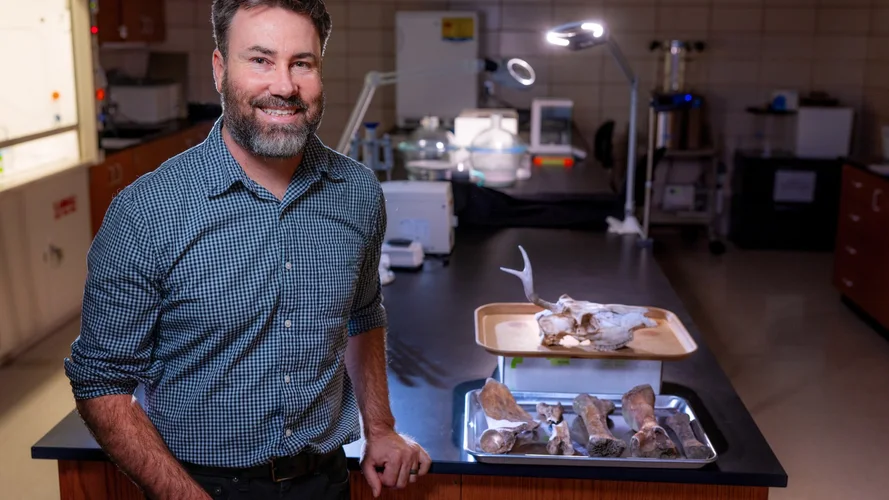
Top photo: Andrew Somerville, associate professor of world languages and cultures at Iowa State University, in his lab with a skull from a white-tailed deer and bones from bison. Photo by Christopher Gannon/Iowa State University.
AMES, Iowa – The oldest evidence of domesticated corn dates back more than 9,000 years, found in the lowlands of the Balsas River Valley in southwest Mexico. Around that time, nomadic hunter-gatherers began selecting, collecting and planting seeds from desirable versions of an annual grass now known as teosinte.
Cultivation slowly transformed teosinte, which at first had small cobs and just a few hard kernels. The crop spread quickly across Central and South America but took longer, about 3,000 years, to get to the Mexican highlands, north and east of corn’s lush birthplace.
In the mountains, the lowlands teosinte was crossed with a variety native to the drier and colder terrain, a key turning point. Nearly all modern corn descends from the lowlands-highlands hybrid, a hardy and productive pairing that likely benefitted from an unusually advantageous climate, new research led by an Iowa State University archaeologist found.
A study led by Andrew Somerville, an associate professor of world languages and cultures at Iowa State, suggests that the expansion of corn cultivation to higher altitudes was enabled by one of the region’s wettest periods in the past 10,000 years, based on analysis of deer and rabbit bones from well-preserved human settlements.
“These favorable growing conditions opened a window for people to successfully transplant corn up into the highlands. Early cultivators could have taken advantage of these conditions to expand their range and hybridize their domesticated maize varieties with highland teosinte,” said Somerville, lead author of the study published in Science Advances.
Bones tell the story
By the time humans in the Americas began to settle in farming communities roughly 4,000 years ago, corn was a staple. But when the crop first made its way to the Mexican highlands about 2,000 years earlier, it was a supplementary food source for mobile societies that also relied on foraging and hunting. While scientists, historians and archaeologists continue to study corn’s early development, much remains uncertain about why and how it became a civilizational cornerstone.
“Given that it’s such an important global crop nutritionally and economically, it’s actually surprising how much there is to learn still about corn’s history and the complicated process it went through to become the corn we know today,” Somerville said.
The research team Somerville led aimed to shed new light on corn’s rise by studying animal bones found within the Tehuacan Valley, a well-known archaeological region surveyed in the 1960s. Dry caves in the mountainous desert-like valley of central Mexico helped protect artifacts from at least 10,000 years of human activity, leading to numerous research projects – including a prior study by Somerville that raised questions about when humans first came to North America.
In the recent study, Somerville and his colleagues examined carbon, oxygen and nitrogen isotopes in about 200 samples of rabbit and deer bones excavated from 10 areas within the Tehuacan Valley, data used to estimate the animals’ diets. Seeing what vegetation was available to the herbivores helped the researchers estimate temperature and precipitation patterns, which also leave direct chemical signatures in bones.
“We look at the chemical composition of bones because your bones are literally made from what you eat,” he said.
Favorable period was clear
Somerville was most interested in what the climate was like both when corn first appeared in the Tehuacan Valley and when farming intensified to provide the food-supply foundation for stationary agricultural communities. There were plenty of bones from when corn arrived in Tehuacan and the centuries after, which allowed researchers to clearly establish the highlands were more humid than usual at the time.
“That’s something we didn’t know before, and I think it’s the biggest finding of the study – maize spread during a really warm and wet period,” he said.
Only a handful of bones analyzed for the study were from the period after the favorable corn-growing climate faded. However, the limited evidence generally supports other studies showing a severe drought in the region – and most of the Northern Hemisphere – just before farming became more prominent, Somerville said.
The presence of a prolonged stretch of colder, drier conditions is of interest because one theory explaining the shift toward sedentary agriculture and the social structure that came with it is that the scarcity produced by a centuries-long drought forced Mesoamericans to optimize their cultivation practices, Somerville said.
“Our data can’t prove that hypothesis, but it’s consistent with it. We do know that as soon as that massive drought is over, pow! Population skyrockets, farming takes off and everyone starts living in villages throughout the year,” he said.
Corn’s rise apparent in dog diet
A separate study from the same research project helps shed light on the pace of corn farming’s growing importance.
In a study also led by Somerville and published this month in Quaternary Science Reviews, researchers analyzed 20 dog bones and teeth from archaeological sites in the Tehuacan Valley. The oldest specimens – which date back about 6,000 years, around the same time corn first arrived in the region – show corn was likely a portion of dogs’ diets. But the domesticated animal’s reliance on corn grew gradually and steadily as permanent agricultural settlements took hold, increasing over about 3,000 years from an estimated 67% of their diet to 85%.
That analysis helps confirm other signs of farming intensifying, such as grinding stones, gardening tools and evidence of people living in one place throughout the year, Somerville said. It also suggests a generation-by-generation improvement in corn production.
“It wasn’t this sudden revolution where they jumped into becoming full-time maize consumers. It slowly grew over time,” he said.
Untangling has upside
Firming up the timeline and circumstances that elevated corn into a prominent role in early human societies is significant in part because corn remains prominent, Somerville said.
“It’s good to know as much as we can about one of the most important plants that we rely on today,” he said.
Somerville said a clearer picture of corn’s winding path to indispensability gives scholars a better grasp of how civilizations develop and provides context that could have practical benefits for improving modern corn.
“If we want to untangle the complex genetic history of corn, the environment’s a crucial part of that,” he said.
Original study: Science Advances, November 2026
Favorable climate helped corn spread across Americas and hybridize in highlands first appeared in Iowa State University News Service.
The research team
From the National Autonomous University of Mexico:
- Isabel Casar, Institute of Physics
- Edith Cienfuegos Alvarado, Institute of Geology
- Laura E. Beramendi-Orosco, Institute of Geology
- Rocío Hernández-Flores, political and social sciences
- Pedro Morales-Puente, Institute of Geology
- Francisco Otero, Institute of Geology
From other institutions:
- Joaquín Arroyo-Cabrales, National Institute of Anthropology and History
- Daniel Dalmas, University of Utah, anthropology
- Kent V. Flannery, University of Michigan, Museum of Anthropological Archaeology
- Andrew Somerville, Iowa State University, world languages and cultures