Dr. Marion Nestle, longtime NYU professor of nutrition, food studies, and public health, with additional faculty roles at UC San Francisco and Cornell, is best known for analyzing the intersections of food, politics, and health, often exposing how government policy, corporate lobbying, and food industry marketing shape what we eat.
A MAHA Win? Trix without petroleum dyes
My forthcoming (September 8) book with Lisa Sutherland, Sugar Coated: Unboxing the Hidden Forces Shaping America’s Favorite Breakfast Food, discusses Make America Healthy Again (MAHA) efforts to remove potentially harmful artificial colors from the food supply.
I just bought the first cereal that dropped those colors and replaced them with vegetable dyes.
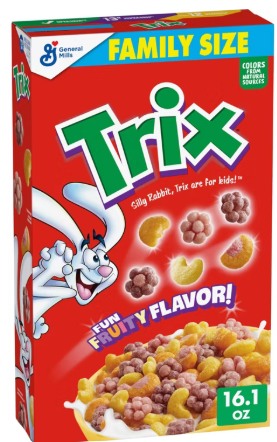
The company did this quietly. I had to look hard to find the green label in the upper right corner saying “colors from natural sources.” Compare the colors of the cereal (pretty close to what it actually looks like) to the original Trix colors, still on the market.
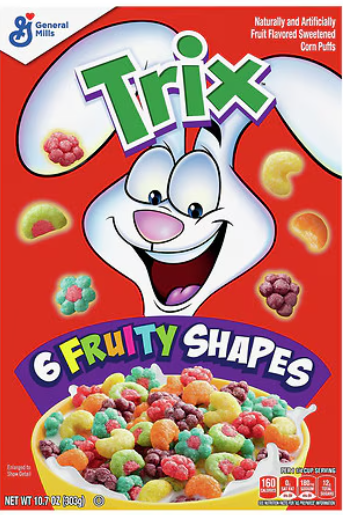
As for the cereals, both:
- Are ultra-processed
- Have artificial flavors and other chemical additives
- Contain 12 grams of sugars per serving
- Contain only 1 gram of fiber
Trix without artificial colors
Whole Grain Corn, Sugar, Corn Meal, Corn Syrup, Maltodextrin, Rice Flour, Canola And/Or Sunflower Oil, Salt, Color (Vegetable And Fruit Juice, Annatto Extract, Turmeric Extract And Other Color Added), Natural And Artificial Flavor, Trisodium Phosphate, Citric Acid, Malic Acid, Rosemary Extract. Vitamins And Minerals
Trix original, with artificial colors
Whole Grain Corn, Sugar, Rice Flour, Corn Syrup, Canola and/or Sunflower Oil, Salt, Trisodium Phosphate, Natural and Artificial Flavor, Red 40, Yellow 6, Blue 1 and Other Color Added, Citric Acid, Malic Acid, Rosemary Extract. Vitamins and Minerals
Comment
Removing the artificial dyes is a good idea, but does not convert Trix to a health food. Alas.
The post A MAHA Win? Trix without petroleum dyes appeared first on Food Politics by Marion Nestle.
Marion Nestle is Paulette Goddard Professor of Nutrition, Food Studies, and Public Health, Emerita, at New York University, which she chaired from 1988-2003 and from which she officially retired in September 2017. She is also Visiting Professor of Nutritional Sciences at Cornell. She earned a Ph.D. in molecular biology and an M.P.H. in public health nutrition from the University of California, Berkeley, and has been awarded honorary degrees from Transylvania University in Kentucky (2012) and from the City University of New York’s Macaulay Honors College (2016). In 2023, she was awarded The Edinburgh Medal (for science and society).